VIDEO VOYAGEUR: 3 Q’s WITH jen M

Jen M

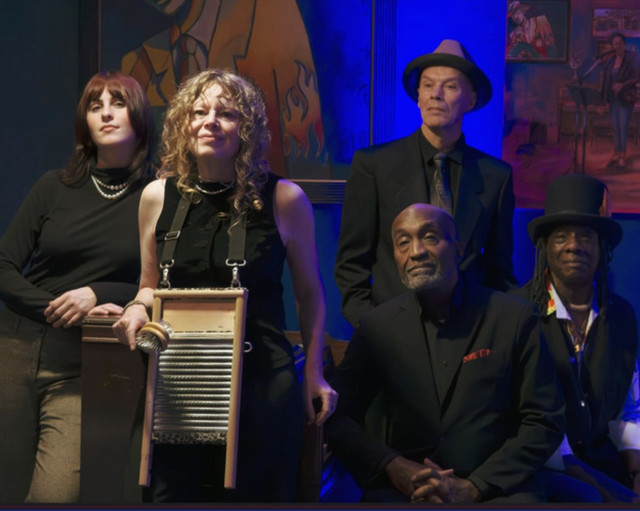
With “Why Don’t You Do Right?”, jen M steps into a new artistic chapter while staying deeply rooted in the blues tradition that shaped Lil’ Red & The Rooster. Featuring Grammy nominated pianist Bobby Floyd alongside collaborators Lauren Tucker, G-Louis, and The Governor this track transforms a familiar jazz standard.

Built from the scratch of a washboard, the sway of bongos, a weathered upright piano, and the twang of a gitjo, the recording creates the atmosphere of a cold New York apartment where survival matters more than glamour. Rather than romanticizing wealth and escapism, jen M’s interpretation focuses on the emotional toll of hard times and the complicated tenderness of tough love. The accompanying video expands that idea visually, contrasting the elegance of a vintage jazz-club setting with the modern reality of working musicians, phone screens and a culture that often consumes art while undervaluing the artists who create it.

At once intimate and socially observant, “Why Don’t You Do Right?” marks the debut of jen M as a solo project and signals an exciting evolution in her creative voice: genre fluid, collaborative, and driven by instinct, storytelling and atmosphere rather than convention.

Tell us the story of this track. Why did you choose to visualize it specifically in this way?

When I hear the lyrics of “Why Don’t You Do Right?” I imagine a young woman demanding her man become her sugar daddy to drape her in diamonds and furs. I don’t relate to that. I imagine a NYC apartment with high ceilings and a bone chill in the air — radiators clanking, electricity flickering. A woman frustrated with her partner worn down into laziness by an oppressive world. Starving, tough love is all she has left to give to get him back on his feet. 

To create this soundscape in the studio I layered the scratch of a washboard with bongos to create the atmosphere. There was a perfectly out-of-tune upright in the corner that Bobby Floyd brought to life. It was like listening to a 1920’s barroom. G-Louis added a soft simple bass line and his banjo guitar with the perfect twangy texture. I wanted to turn the song into a duet. We didn’t think too much about why there are two women in this situation, we leave that up to your imagination. I didn’t need to give Lauren much direction we entwined our voices instinctively in the moment. It only took two takes. That created the music. 

I’m a very intuitive creator. I love puzzles. In grad school at Naropa University, I studied a technique for theatre creation called Moment Work by Moises Kauffman. In this technique you start with a story or idea or question or theme and then instead of writing a story you create moments that relate to the theme. They can be anything. Once you have them you weed them and then arrange them like pearls on a string. I love this way of working. It doesn’t have to be linear or necessarily clear point to point. It can be a series of impressions, senses and experiences. So, for this project, I didn’t want to tell the story of the lyrics or my impression of them. I think it’s strong enough in the music. I didn’t want to explain. I want it to be a different experience for everyone. 

What was the inspiration behind this new video (visuals, storyline, etc.)?

I wanted to play with the dichotomy between the musicians on stage making the same hundred bucks a gig they did in the 80’s and a wealthy public of art lovers. They all love music and that love becomes the excuse for a culture to starve their artists because … well, “they love what they do.” And we do, and we’d love to live better without begging for each dollar. So we have that artist cry for culture to do better and get us some money too. 

So, I asked our fans to come to our favorite coffee shop Java Central in my home town Westerville, Ohio dressed to the nines. I told them to not hold back, bring out those diamonds and pearls and they did, including my mom. We put white table cloths on the tables with crystal wine and cocktail glasses. Dimmed the lights and turned it into a NYC jazz club vibe. 

I’m also fascinated by the new phone filming art trend. I’m not anti or pro, I accept it for what it is, a new way of sharing art with others. I wanted to bring that element into the video like a veil over being present in the moment. Veil’s can have their beauty too. 

Another element I wanted to explore was using black & white of the past in contrast to vivid color of now.

What was the process of making the video?

Our friend and videographer Bill Jingo helped me set up a GoPro, iPad and iPhone as three static full scene camera angles. Then he shot close-ups with a hand-held iPhone holder. The venue has stage lighting and a really beautiful blue wall next to brick and an old upright piano. I chose the space for that blue wall. There’s also a painting of a dear friend and fellow musician who passed away a few years back. 

The band came dressed for a high-end gig. I played the recording live and we doubled it with voices and instruments, which meant we all had to relearn our parts. It’s not as easy as it sounds. The fans sat down in front of the stage and played their part. We did three takes plus close-ups. One take I asked them to get their phones out and film the soloists. They got really into it with one guy doing a selfie with the band in the background. The footage is really quite beautiful when layered over like that veil I was referring to. 

My favorite moment is a slow motion money grabbing moment. I took the tip jar and grabbed all the money and threw it in the air. All the musicians grabbed for it while the audience was filming it with their phones. Funny thing, one bill got stuck in the ceiling panels.  

Another funny moment, while filming Bobby’s closeup on his solo, G-Louis started playing his gitjo behind his head like an electric guitar. The public started laughing of course and Bill caught Bobby and Governor’s expression of delight and surprise. I didn’t use the behind the head shot, but the shot of Bobby and The Governor is in the video. Look for it during the guitar solo. 

Bill did such a beautiful job with the filming that editing was effortless. It was all intuitive. When I finished I realized I’d naturally bookended the video in black & white with the washboard. 

Life Between the Lines: Bobbo Byrnes and the Reality of the Touring Musician

toomanymiles2

Despite spending more than two decades on the road, and playing everywhere from living rooms to festival stages across the U.S. and Europe, Bobbo Byrnes has largely remained just outside the traditional spotlight. Therefore, it feels appropriate that his memoir, Too Many Miles: On the Road with an Unofficial Rock & Roll Goodwill Ambassador, doesn’t focus on a single breakthrough moment or career peak, but instead captures the long, winding road of a working musician who has built his life one show, one connection and one mile at a time.

This is not a typical rock memoir filled with tales of excess or industry mythology, nor is it strictly a travelogue. Alhough it does contain elements of both. While Byrnes does recount the expected stories the book quickly expands into something broader. It becomes a reflection on what it means to exist in that middle space of the music world: not unknown but not quite mainstream either, working within a global network of small venues, house concerts and grassroots connections.

Byrnes’s early years and evolution as a musician are touched on throughout, from his beginnings in the Boston music scene to his eventual relocation to Southern California and the formation of his band, The Fallen Stars. These formative experiences are presented as part of an ongoing continuum, one that includes constant touring, creative partnerships and the gradual shaping of his identity as both an artist and a storyteller.

A significant portion of the book focuses on Byrnes’s experiences touring internationally, particularly in Europe where his role often extends beyond performer. Much like the best travel writing, these sections highlight not just where he goes but how he is received along the way.

Encounters with audiences frequently shift from music to conversations about American culture, politics and identity, placing Byrnes in an unexpected position of informal ambassador. These moments, including a tense radio interview in Germany and performances for diverse audiences, underscore the idea that music can serve as a bridge in ways that more formal channels often cannot.

Parallel to these stories is the recurring theme of connection and how fleeting interactions with strangers can leave lasting impressions. Whether it’s a conversation after a show, a shared meal or a collaborative moment with fellow musicians, Byrnes emphasizes the communal aspect of a life on the road. In doing so, he subtly pushes back against the notion of the lone artist, instead illustrating how his career has been shaped by countless individuals along the way.

Stylistically, the book mirrors Byrnes’s songwriting with its direct and conversational tone. There is little attempt to mythologize events or even elevate them beyond what they are. Instead, the strength lies in accumulation, in the gradual layering of stories that, taken together, form a clear picture of a life defined not by a sigular achievement but by persistence.

While the book stands out on its own, it also exists alongside a companion album which echoes many of the same themes. Much like the memoir, Byrnes’s music draws from years of travel and observation, reinforcing the idea that Byrnes’ songs and stories are inseparable parts of the same narrative.

If there is an overarching takeaway, it is that careers like this rarely follow a straight line. There is not a single defining moment or arrival point but just the work itself: the writing, the traveling, the performing and the decision to keep on going. If the realities of independent touring, the intersection of culture and songwriting and the quieter stories that exist beyond the mainstream music industry are of interest, then Too Many Miles is well worth the journey.

Connect with Bobbo Byrnes on his Website