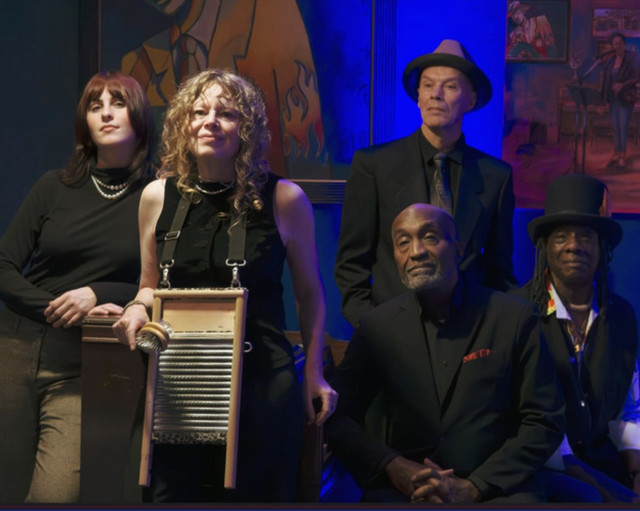
With “Why Don’t You Do Right?”, jen M steps into a new artistic chapter while staying deeply rooted in the blues tradition that shaped Lil’ Red & The Rooster. Featuring Grammy nominated pianist Bobby Floyd alongside collaborators Lauren Tucker, G-Louis, and The Governor this track transforms a familiar jazz standard.
Built from the scratch of a washboard, the sway of bongos, a weathered upright piano, and the twang of a gitjo, the recording creates the atmosphere of a cold New York apartment where survival matters more than glamour. Rather than romanticizing wealth and escapism, jen M’s interpretation focuses on the emotional toll of hard times and the complicated tenderness of tough love. The accompanying video expands that idea visually, contrasting the elegance of a vintage jazz-club setting with the modern reality of working musicians, phone screens and a culture that often consumes art while undervaluing the artists who create it.
At once intimate and socially observant, “Why Don’t You Do Right?” marks the debut of jen M as a solo project and signals an exciting evolution in her creative voice: genre fluid, collaborative, and driven by instinct, storytelling and atmosphere rather than convention.
Tell us the story of this track. Why did you choose to visualize it specifically in this way?
When I hear the lyrics of “Why Don’t You Do Right?” I imagine a young woman demanding her man become her sugar daddy to drape her in diamonds and furs. I don’t relate to that. I imagine a NYC apartment with high ceilings and a bone chill in the air — radiators clanking, electricity flickering. A woman frustrated with her partner worn down into laziness by an oppressive world. Starving, tough love is all she has left to give to get him back on his feet.
To create this soundscape in the studio I layered the scratch of a washboard with bongos to create the atmosphere. There was a perfectly out-of-tune upright in the corner that Bobby Floyd brought to life. It was like listening to a 1920’s barroom. G-Louis added a soft simple bass line and his banjo guitar with the perfect twangy texture. I wanted to turn the song into a duet. We didn’t think too much about why there are two women in this situation, we leave that up to your imagination. I didn’t need to give Lauren much direction we entwined our voices instinctively in the moment. It only took two takes. That created the music.
I’m a very intuitive creator. I love puzzles. In grad school at Naropa University, I studied a technique for theatre creation called Moment Work by Moises Kauffman. In this technique you start with a story or idea or question or theme and then instead of writing a story you create moments that relate to the theme. They can be anything. Once you have them you weed them and then arrange them like pearls on a string. I love this way of working. It doesn’t have to be linear or necessarily clear point to point. It can be a series of impressions, senses and experiences. So, for this project, I didn’t want to tell the story of the lyrics or my impression of them. I think it’s strong enough in the music. I didn’t want to explain. I want it to be a different experience for everyone.
What was the inspiration behind this new video (visuals, storyline, etc.)?
I wanted to play with the dichotomy between the musicians on stage making the same hundred bucks a gig they did in the 80’s and a wealthy public of art lovers. They all love music and that love becomes the excuse for a culture to starve their artists because … well, “they love what they do.” And we do, and we’d love to live better without begging for each dollar. So we have that artist cry for culture to do better and get us some money too.
So, I asked our fans to come to our favorite coffee shop Java Central in my home town Westerville, Ohio dressed to the nines. I told them to not hold back, bring out those diamonds and pearls and they did, including my mom. We put white table cloths on the tables with crystal wine and cocktail glasses. Dimmed the lights and turned it into a NYC jazz club vibe.
I’m also fascinated by the new phone filming art trend. I’m not anti or pro, I accept it for what it is, a new way of sharing art with others. I wanted to bring that element into the video like a veil over being present in the moment. Veil’s can have their beauty too.
Another element I wanted to explore was using black & white of the past in contrast to vivid color of now.
What was the process of making the video?
Our friend and videographer Bill Jingo helped me set up a GoPro, iPad and iPhone as three static full scene camera angles. Then he shot close-ups with a hand-held iPhone holder. The venue has stage lighting and a really beautiful blue wall next to brick and an old upright piano. I chose the space for that blue wall. There’s also a painting of a dear friend and fellow musician who passed away a few years back.
The band came dressed for a high-end gig. I played the recording live and we doubled it with voices and instruments, which meant we all had to relearn our parts. It’s not as easy as it sounds. The fans sat down in front of the stage and played their part. We did three takes plus close-ups. One take I asked them to get their phones out and film the soloists. They got really into it with one guy doing a selfie with the band in the background. The footage is really quite beautiful when layered over like that veil I was referring to.
My favorite moment is a slow motion money grabbing moment. I took the tip jar and grabbed all the money and threw it in the air. All the musicians grabbed for it while the audience was filming it with their phones. Funny thing, one bill got stuck in the ceiling panels.
Another funny moment, while filming Bobby’s closeup on his solo, G-Louis started playing his gitjo behind his head like an electric guitar. The public started laughing of course and Bill caught Bobby and Governor’s expression of delight and surprise. I didn’t use the behind the head shot, but the shot of Bobby and The Governor is in the video. Look for it during the guitar solo.
Bill did such a beautiful job with the filming that editing was effortless. It was all intuitive. When I finished I realized I’d naturally bookended the video in black & white with the washboard.

