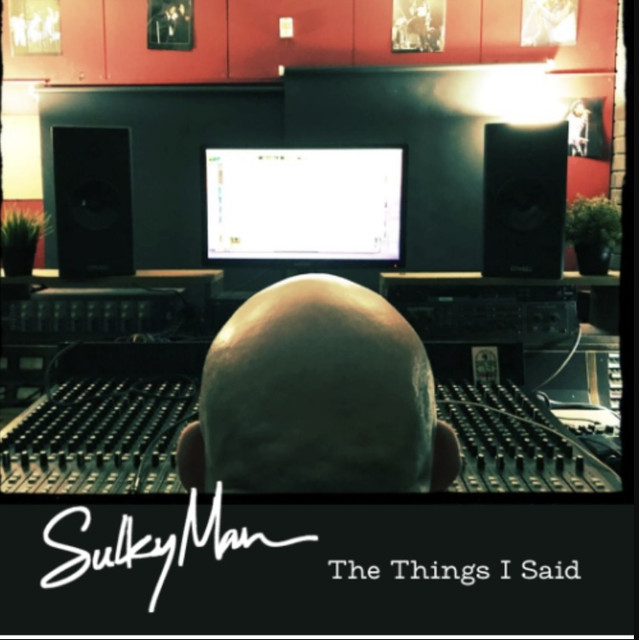
Three decades is a long time for a song to wait to be heard. Somewhere between the hiss of an old four-track recorder and the shifting currents of London’s underground music scene, Chris Pascoe captured a handful of ideas that would eventually slip out of view, leaving four recordings to gather dust while life took him in other directions. Now, as SulkyMan, he has brought them back into the light, and the results are a fascinating glimpse into a period when guitar music could be gloriously wayward, instinctive and unconcerned with staying in its lane.
Recorded around 1995 on a Yamaha MT50 four track analogue recorder, these songs have survived without losing the curious energy that made them worth recording in the first place. There are wiry guitars, restless rhythms, unexpected melodic turns and an appealing roughness that feels inseparable from their character. Rather than sounding like relics retrieved for nostalgia’s sake, the four tracks reveal a songwriter already comfortable following an idea wherever it leads. What emerges is not simply a document of Pascoe’s musical past, but a reminder that some songs can outlive the circumstances in which they were created and still have a few surprises left.
Listen here:
The title track opens the collection with shimmering jangling guitars and a beautifully measured bass part that gives the arrangement warmth and movement. There is a natural swing to the music, an ease in the way the melodic elements find their places, and spaciousness that allows the song to unfold without losing its infectious quality. It has the DNA of classic nineties indie, when guitar bands could be melodic without becoming predictable and atmospheric without disappearing into their own introspection. Yet there is something appealingly timeless about it, too. Had “The Things I Said” emerged during the original heyday of the Britpop era, it would not have sounded out of place. Heard now, it carries the pleasure of discovering a song that has somehow escaped the usual boundaries of its time.
“I Wonder Why” takes a more unsettled route. The guitars have a nervous, slightly careering quality, moving between melodic passages and rougher, more insistent textures. There are shadows of post punk in the atmosphere, with something of Echo & the Bunnymen’s brooding musicality and the ragged charm associated with Nikki Sudden. The bass deserves particular attention here, providing a fluid counterpoint to the guitars and giving the song much of its distinctive character. It is an arrangement that thrives on the interplay between its parts, with tension and melody pulling against one another in a way that keeps the listener engaged.
“Nothing Is Easy” brings a sharper edge to the collection. Its angular guitar work and snarling delivery suggest a song with little patience for easy answers, while unexpected melodic turns lend it a more playful character than the title might imply. There is a hint of the Beatles in the way the melody seems to emerge from within the song’s rougher exterior, a reminder that memorable pop instincts can survive even the most unconventional arrangements. Pascoe seems comfortable allowing these contrasting elements to coexist.
“Never Change” completes the quartet with a nod towards the more restless end of new wave and post-punk. There is a tautness to the song, a sense of unresolved movement that suits the material, while its melodic instincts keep it from becoming overly austere. Across these four recordings, that balance between accessibility and eccentricity becomes one of SulkyMan’s defining qualities. Pascoe understands that a song can be catchy without being obvious, and rough around the edges without sacrificing musical detail.
What makes the collection particularly interesting is the knowledge that these recordings represent an earlier stage in an ongoing creative life. Pascoe has travelled an unusual musical road, from his teenage years playing bass in London anarcho-punk band Part 1 to his later involvement in the underground tech-house scene, before developing SulkyMan into a solo project in which he writes, performs, records and produces his own material. Across those different worlds, he has consistently followed his own instincts rather than settling into one recognisable musical identity.
The songs collected here reveal the foundations of that independence. There is an instinctive understanding of arrangement, a willingness to let contrasting moods sit alongside one another, and a melodic sensibility that prevents the music from becoming an exercise in obscurity. The analogue limitations may have influenced the way these recordings were made, but they have not diminished their character. Instead, the music retains the sense of discovery that comes from an artist working things out for himself, following a line of thought wherever it happens to lead.
There is also something quietly moving about hearing music return after so much time. Thirty years can change the meaning of a song, even when the recording itself remains untouched. Lines written in one period of life inevitably acquire different shades of meaning when heard from another, while the sound of a younger self can become an unexpected conversation between past and present. Pascoe has spoken of his amazement at finding these recordings again, and it is easy to understand the appeal of bringing them into the world after believing they had disappeared from view.
The beauty of “The Things I Said” and its companion tracks is that they do not need their history to justify their existence. The story behind their recovery adds interest, certainly, but the music stands on its own merits. The guitars have character, the bass lines reward attention, and the melodies linger long after the songs have finished. More than anything, there is a sense of artistic freedom running through the collection, the sound of someone making music because the ideas are there and need to be followed.
Plenty of recordings from the nineties survive as nostalgic souvenirs of a particular scene or sound. SulkyMan’s rediscovered material offers something more satisfying. These four songs feel like fragments of an unfinished conversation, recovered from the past and given another chance to be heard. They are reminders that good songwriting does not necessarily come with an expiry date, and that the passage of time can occasionally turn a forgotten recording into a new beginning.
For Chris Pascoe, the past has proved to be a surprisingly fertile place to start again. With “The Things I Said”, SulkyMan brings a long-lost piece of musical history back into circulation, and finds that the songs still have plenty of life left in them.
About SulkyMan
SulkyMan is the solo project of London musician Chris Pascoe, a songwriter and multi-instrumentalist whose musical journey spans the worlds of anarcho-punk, underground electronic music and alternative guitar rock. Beginning his musical life as a teenage bass player in London anarcho-punk band Part 1, Pascoe went on to explore the underground tech house scene before developing SulkyMan as a space for his own songwriting, recording and production.
His music brings together melodic instinct, restless guitar work and a willingness to explore the space between indie rock, post-punk and pop. Unconcerned with genre boundaries, Pascoe follows his ideas wherever they lead, balancing angular arrangements and rough edged textures with memorable melodies.
SulkyMan’s latest release, The Things I Said, brings four recordings made around 1995 on a Yamaha MT50 four-track analogue recorder back into circulation. Rediscovered decades after their original creation, the tracks offer a glimpse into Pascoe’s earlier creative life, preserving the spontaneity and independent spirit of the era while revealing a songwriter whose musical instincts have stood the test of time. Rather than simply revisiting the past, SulkyMan gives these long-lost recordings a new life, allowing their distinctive character to find an audience in the present.
Connect with SulkyMan:

