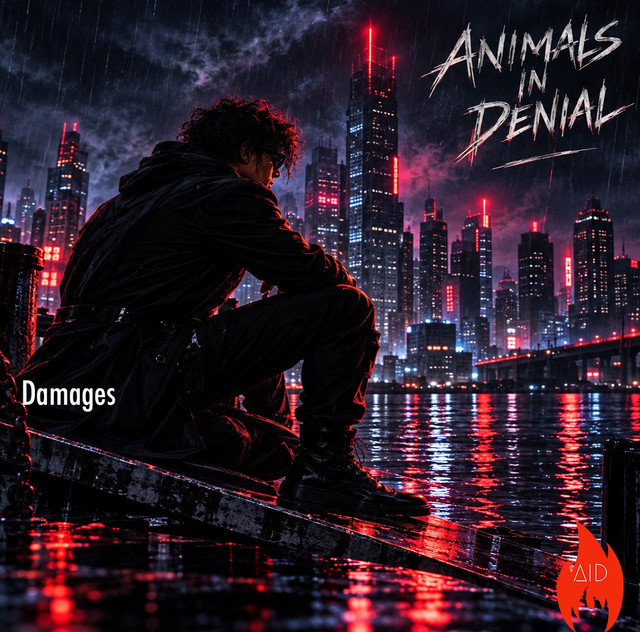
There is a kind of honesty that comes from looking back at difficult experiences without pretending they never happened, and without allowing them to define everything that follows. On “Damages,” the latest single from Animals in Denial, Christian Ines explores that difficult territory with a song that feels as much like a private reckoning as a piece of music. Intimate in its arrangement and deeply personal in its subject matter, it considers what happens when trust is broken, the foundations we have built our lives upon begin to shift, and we are left to work out what to do with the pieces.
Originally released on Millennial, “Damages” has now been revisited by Ines, who has taken the opportunity to restore vocal parts and harmonies that he had originally envisaged but could not fully realise with the recording equipment available at the time. The updated version brings the song closer to his original intentions, allowing its emotional subtleties to emerge while preserving the understated character that made the recording work in the first place.
Listen here:
Musically, the appeal lies in its simplicity. Built around a vintage Stratocaster and bass, the arrangement has an immediacy that more elaborate production might have obscured. Ines kept the very first guitar take, played on his ’50s Stratocaster using a capo and the neck pickup, trusting the instinctive quality of that initial performance rather than pursuing a technically polished alternative. The bass, played on his wife’s Rogue, brings its own character to the song and reflects a period in which he was beginning to understand the instrument as something more than a means of reinforcing the guitar.
There is no need for a conventional drum part or a towering wall of sound. Instead, the instruments occupy a space that feels almost domestic, as though the listener has arrived in a room where the song is unfolding in real time. A vinyl effect at the beginning creates the impression of tuning into a radio station just as the music starts, a small production detail that establishes the atmosphere without drawing attention away from the performance. It is an inviting introduction to a song whose emotional subject matter is considerably more complicated than its modest arrangement might initially suggest.
That contrast is central to the track’s appeal. Ines is more interested in the lasting effects of broken trust, and in the slow, often difficult process of understanding how those experiences have shaped the person he has become. The song draws on his experiences of relationships, people and institutions that have failed to live up to the trust he placed in them, including events that began early in his life and influenced how he came to understand the world around him.
Yet this is not simply a song about disappointment. Its deeper concern is what happens after the initial hurt, when the immediate crisis has passed but the consequences remain. How do you rebuild your sense of security? How do you learn to trust again without ignoring what experience has taught you? And how do you move forward when the person you become in the process is inevitably different from the person you were before?
Ines approaches these questions with a refreshing lack of sentimentality. Healing is not presented as a neat return to the way things were, nor does the song suggest that difficult experiences can simply be erased. Sometimes the pieces do not fit together as they once did. You have to find a different way of putting them together, accepting that change is part of the process rather than evidence that something has been lost forever.
The decision to revisit “Damages” also gives the song an interesting second life. Restoring the backing vocals and harmonies has allowed Ines to hear the track closer to the way he originally imagined it, but the process is about more than correcting the limitations of an earlier recording. It is also an opportunity to reconsider a deeply personal piece of work from a different point in his life. The song remains connected to the experiences that inspired it, but the perspective surrounding those experiences has evolved.
Ultimately, “Damages” is about acknowledging what has happened without surrendering the future to it. The title might suggest something broken beyond repair, but the song arrives at a more complicated and ultimately hopeful understanding. Damage can leave its mark. It can alter the way we see ourselves, the people around us and the possibilities ahead. But it does not have to determine the outcome.
Sometimes moving forwards means accepting that you will never be quite the same person again. “Damages” understands that, and finds something quietly powerful in the realisation that this need not be a bad thing.
Keep up with everything Animals In Denial on the Website

