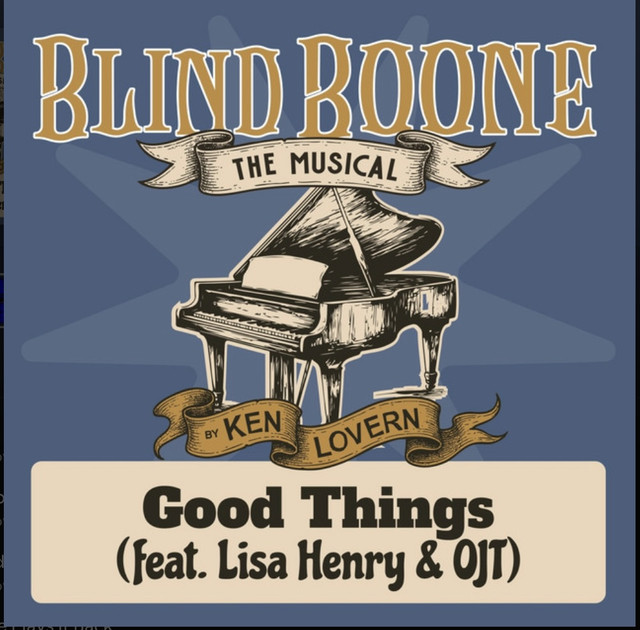
There is something fitting about ending a story with a song called “Good Things.” After the hardship, uncertainty and extraordinary circumstances explored throughout Blind Boone the Musical, Ken Lovern’s fourth and final single arrives with a sense of warmth and forward motion. It settles into the groove and lets the music do what it does best – brings people together.
At the centre of the track is Lisa Henry, whose vocals give “Good Things” its human warmth. There is an easy to her performance that immediately draws you in. She is surrounded by the unmistakable sound of OJT (Organ Jazz Trio), the Kansas City organ-jazz outfit with whom Lovern spent more than thirteen years performing at the city’s Green Lady Lounge.
That history matters. Lovern isn’t approaching organ jazz as an aesthetic borrowed for the occasion; it is part of his musical vocabulary. The Hammond organ sits comfortably at the heart of the arrangement, giving the track its earthy character while the rhythm section keeps everything moving with the relaxed confidence of musicians who know exactly where the groove is. And then there is Robert Rebeck’s shaker.
It might sound like a small detail, but it is precisely those details that give “Good Things” its personality. The shaker adds another rhythmic layer to the arrangement, contributing to the sense that this is music made to be experienced physically. You can feel the pulse as much as hear it.
Listen here:
The emphasis on groove is central to Lovern’s wider approach. His work on Blind Boone the Musical has never been about creating a museum piece reconstruction of nineteenth-century music. Instead, he takes the history of Boone and filters it through the musical traditions that have shaped his own life: jazz, ragtime, blues, gospel, classical music and contemporary American sounds. “Good Things” perhaps captures that philosophy better than any of the previous singles.
The earlier releases have taken listeners through very different chapters of Boone’s story. “Quindaro” looked towards his family’s history and the search for freedom. “School for the Blind” explored the young Boone’s developing musical abilities. “Boone Plays It Back” introduced the virtuoso and the extraordinary talent that would eventually make him a celebrated performer. Here, the atmosphere is different.
That doesn’t mean the track ignores the complexity behind Boone’s story. Quite the opposite. The warmth of “Good Things” feels more meaningful because we know what has come before it. Boone’s achievements existed alongside blindness, racism, exploitation and the many barriers faced by Black performers in nineteenth and early twentieth-century America. To end the project’s sequence of singles with a song that embraces optimism feels less like glossing over those realities and more like acknowledging the resilience that allowed Boone to overcome them.
There is also a pleasing circularity to the release. Lovern began this project after discovering Boone’s story almost by accident, becoming fascinated by a musician who had once been famous enough for a Kansas City theatre to bear his name but had since slipped from popular memory. Now, through these songs, Boone’s story is being placed back into the musical conversation. “Good Things” works because Lisa Henry’s vocals, OJT’s organ driven groove and Rebeck’s percussion combine into something loose, soulful and unmistakably alive.
And perhaps that is exactly how this chapter should end. Not with a solemn farewell, but with real groove. Not with the past being put to bed, but with the feeling that there is more music still to discover. With “Good Things,” Ken Lovern closes the singles campaign for Blind Boone the Musical on an uplifting note.

About Ken Lovern
Ken Lovern is a Kansas City based composer, jazz organist and storyteller whose work blends the influences of jazz, ragtime, blues, gospel, classical and American roots music. He is the creator, composer and lyricist behind Blind Boone the Musical, an original historical musical fantasy exploring the life of Missouri pianist and composer John William “Blind” Boone.
Lovern has spent more than three decades performing and composing across a wide range of musical styles. For more than thirteen years, he played Hammond organ with his group OJT (Organ Jazz Trio) at Kansas City’s legendary Green Lady Lounge, performing four or five nights a week and becoming a familiar presence in the city’s celebrated jazz scene. His jazz compositions can also be heard across numerous OJT releases, including the album Ground Level.
With Blind Boone the Musical, Lovern combines his experience as a live jazz musician with theatrical storytelling to bring the remarkable story of Blind Boone to contemporary audiences. The full project, including vinyl and CD editions and a companion graphic novel, is set for release September 2, 2026.

