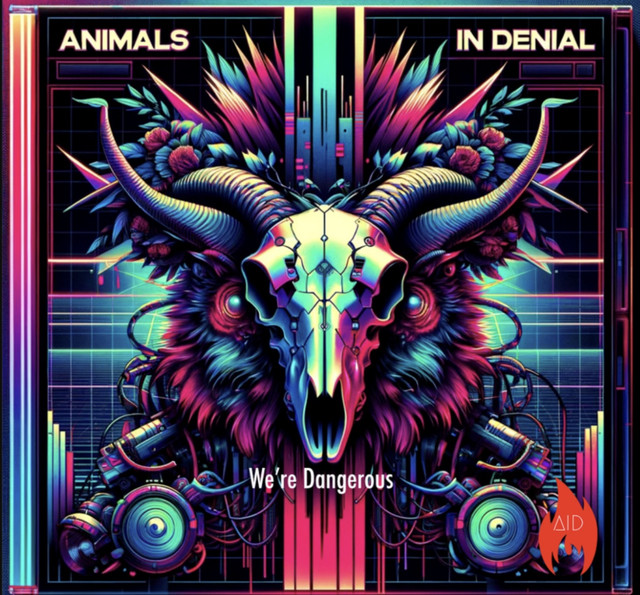
“We’re Dangerous” arrives like a signal bleeding through from somewhere slightly off-grid. It’s too loud, too dense, too emotionally charged to behave itself in the way modern alt-rock often politely insists it should.
Animals in Denial don’t seem interested in that politeness anyway. Christian Imes builds this thing like he’s holding multiple ideas in his hands at once and refusing to drop any of them, even if they clash, even if they spark, even if they threaten to overload the system.
There’s an almost basement level urgency running through the track, the kind you used to hear when bands had something to prove and not much interest in smoothing the edges for wider consumption. Guitars are stacked and slightly unruly, not in a sloppy way, but in a way that feels human with small variations left in the mix, textures allowed to overlap instead of being neatly separated into their own lanes. It doesn’t sound “produced” so much as assembled under pressure like the song might have broken out of the room if it had been given just one more pass.
And yet, for all that abrasion, there’s something strangely controlled underneath it. The drums hold steady like a metronome refusing to be dragged into chaos. The bass sits deeper in the structure, doing its job without calling attention to itself. It’s the tension between those grounding elements and the surrounding noise that gives the track its shape. Without that discipline, it would collapse into pure distortion.
“We’re Dangerous” is a song about being misread. About generational friction. About the way language gets flattened when one group looks at another and decides it already understands them. But unlike a lot of modern “statement” tracks, it doesn’t reduce that idea into slogans or clean takes.
There’s a moment in the track where everything feels like it’s pushing slightly out of alignment with layers pressing against each other, vocals cutting through. That’s where the song really clicks.
And that’s something a lot of modern alternative music seems to have forgotten how to do. “We’re Dangerous” does the opposite. It leans into friction. It lets the rough edges stay visible. It trusts that intensity doesn’t need to be smoothed in order to be understood.
Is it chaotic? Absolutely.
Is it controlled? Just enough.
Is it necessary? That’s the real question.
Because somewhere inside all that distortion and density, there’s a clarity and the sense that this is what it sounds like when someone refuses to simplify themselves for easy interpretation.
It’s loud, it’s uncomfortable, and it doesn’t apologize for either of those things.
Keep up with Animals In Denial on the Website
Stream music on Spotify and YouTube Music

