
Improvisational pianist Mario Mattia continues to develop a deeply personal and exploratory musical language that exists somewhere between contemporary classical music, jazz improvisation and spontaneous composition. Rather than approaching improvisation as display or variation, Mattia treats it as a form of real-time architecture, shaping long form musical ideas through instinct, harmonic intuition, rhythm and emotional atmosphere.
His recent work has increasingly focused on the relationship between sound, abstraction, visual identity and spontaneous creation. With works such as Origin, Invention, The Unfolding Field, and now Abstract Boogie revealing different dimensions of his improvisational world.
In this exclusive feature, Mattia discusses the creation of Abstract Boogie, the tension between rhythmic propulsion and abstraction within the performance, and the visual language he has developed around his improvisational practice, including the symbolic Möbius imagery that connects his various musical forms.
The result is an artistic approach that is completely unique: grounded in the spontaneity of performance whilst also reaching towards something more immersive and deeply personal.
Tell us the story of this track. Why did you choose to visualize this it specifically in this way?
Abstract Boogie began spontaneously in my studio. It was not a preconceived composition, nor was it something I had planned in advance. I was recording in the moment, and the piece emerged from a chromatic, boogie-derived left-hand pattern that immediately took on a strong physical momentum. From there, the improvisation developed naturally, with the right hand moving in a more abstract, technically active direction above that driving foundation.
What interested me was the tension between that insistent left-hand engine and the more abstract, technically active right hand that emerged above it. It is not traditional boogie-woogie, but rather an improvisation that uses the rhythmic drive of boogie as a foundation for something freer, more chromatic, and more contemporary.
The visuals were chosen to reflect that intensity – the motion, pressure, and forward propulsion of the improvisation. The occasional glimpse of me at the piano is there to remind the viewer that this is a real-time performance, not something assembled or constructed afterward. I wanted the video to feel immersive, energetic, and slightly unstable, much like the music itself.
What was the inspiration behind this new video (visuals, storyline, etc.)?
The inspiration was less about creating a literal storyline and more about finding visuals that could reflect the internal energy of the improvisation. Abstract Boogie has a restless, driving quality – the left hand keeps pushing forward while the right hand moves in a more angular and unpredictable way – so I wanted the video to feel active, intense, and somewhat abstract.
The imagery is meant to mirror that sense of propulsion and tension rather than explain the music in a narrative way. I was drawn to visuals that had movement, contrast, and a slightly unstable quality, because that seemed closest to what the improvisation itself was doing. The occasional image of me at the piano gives the viewer a human point of reference and reinforces that this was a spontaneous, real-time performance.
What was the process of making the video?
The process began with searching for visual material that felt compatible with the intensity and motion of the improvisation. Because Abstract Boogie has such a strong physical drive, I wanted imagery that had energy, abstraction, and a sense of forward movement rather than anything too literal or decorative.
From there, I incorporated my abstract Möbius image, one of three Möbius images I use as visual signatures for the different improvisational areas I work in: meditative (blue), abstract (magenta), and freeform (green blend). Each image has its own distinct color identity, corresponding to the character of that particular genre. The meditative works tend to suggest stillness, depth, and inward motion; the abstract pieces are more angular, chromatic, and unstable; and the freeform improvisations are the most open-ended and exploratory. For Abstract Boogie, I used the abstract Möbius image because its color and visual character represents the intensity, tension, and unpredictability of the performance. The occasional images of me at the piano serve as a reminder that, beneath the abstraction, this is still a spontaneous real-time performance by a single musician responding in the moment.
I assembled and refined the video in DaVinci Resolve, working with the pacing, transitions, placement of images, and overall visual atmosphere until it felt aligned with the music. The goal was not to create a conventional storyline, but to build a visual environment that followed the momentum, intensity, and unpredictability of the performance.
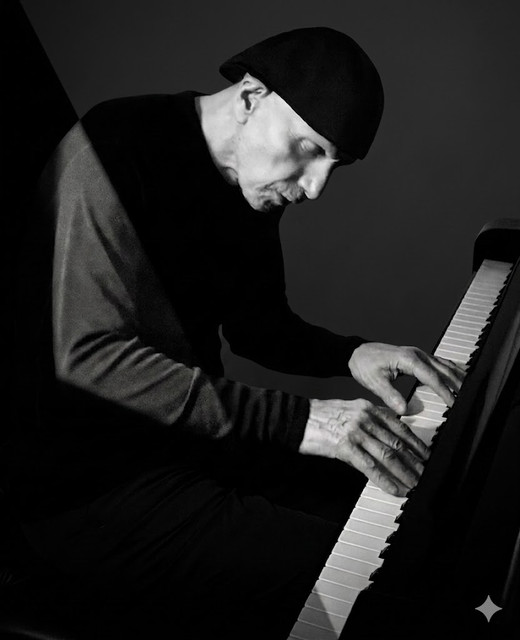
About Mario Mattia
Mario Mattia is an improvisational pianist and graduate of the New England Conservatory whose work is rooted in spontaneity, deep listening and emotional presence. Drawing on influences ranging from Johann Sebastian Bach to Keith Jarrett and Brian Eno, his music bridges classical, jazz, progressive and ambient traditions.
Each performance is created entirely in the moment, without predetermined themes or structures. While his primary work centers on solo piano improvisation, Mattia also maintains an electronic studio practice that serves as a parallel and occasional extension of his explorations in sound.
Working from his rural studio, Mattia captures every nuance of sound, inviting listeners into immersive, contemplative spaces where music unfolds as lived experience.
Keep up with everything Mario Mattia on his Website

