Hard rock band TubeFreeks have just dropped their latest single, “Rise,” co-written by Clint Lowery of Sevendust. The song also features a vocal cameo by Lowery in the verses. “Rise” carries the momentum from the band’s previous single, “Flower,” also co-written by Lowery. The track opens with a synth-driven sequence that feels like it would be right at home in a late-night heist or hacker film’s soundtrack, before settling into a high-impact, riff-based charge that grounds it firmly in the band’s identity. Although “Rise” reaches back to artists defined by emotional intensity and polished aggression from the 2000s hard rock era, it also feels new again. The rhythm has a discernible gallop, giving the song a sense of forward motion that it sustains throughout, with a chorus that employs double-kick elements without going overboard. There’s a certain control at play, a tension that it sustains without ever seeking release.
The guitar work brings a slight subversion of expectations, providing texture and character to the sound while keeping it firmly rooted in its core weight. There is an almost exotic feel to parts of the guitar playing that adds depth and color to the sound, yet keeps it firmly rooted in its core weight. Paul van Valkenburgh gives one of his strongest performances vocally, hitting with a full-bodied quality that feels less about theatrics and more about control, carrying the track forward with a sound that feels both distinct and grounded. “Rise” stays grounded in the elements that made this style resonate, tightening the execution and pushing it forward. It’s a track that is focused, direct, and built to move, with more still on the horizon.
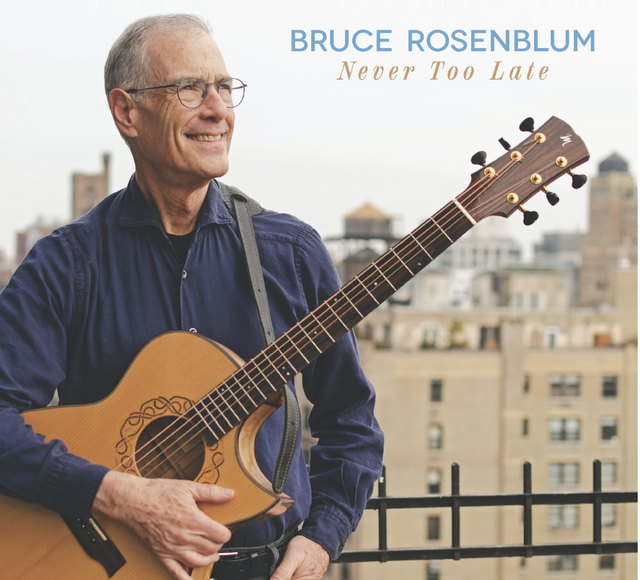
Some albums announce themselves loudly, demanding attention from the opening seconds with oversized hooks or layers of production designed to overwhelm the listener. Bruce Rosenblum’s new album Never Too Late takes a very different path.
This latest release draws the listener in through atmosphere, detail and a quietly confident sense of his craft. It is less like a performance looking for an applause and more of an invitation into a carefully shaped musical world.
The album sits within the broad singer songwriter tradition, but Rosenblum doesn’t treat genre as a fixed destination. Folk is the framework here certainly, yet these songs continually allow for other influences to surface naturally. Jazz phrasing winds through the melodies, classical textures deepen the emotions and country folk touches add warmth and movement. Rather than sounding stylistically scattered, the album feels unified by curiosity and by Rosenblum’s willingness to follow wherever each song naturally takes us.
“My Way Home” opens the record with an easy charm that immediately establishes the album’s tone. Written during the isolation of the COVID lockdown, the song explores the paralysis that can come from overthinking life and avoiding difficult choices. Rosenblum delivers it with wit and lightness, and allows the humor in the lyrics to soften the edges of the message. Musically, the New Orleans inflected groove gives the song a relaxed momentum, while clarinet lines drift through the arrangement with a playful energy that keeps everything in motion.
Elsewhere, “Undertow” reveals a more introspective side of the album. Inspired by long walks on nearly empty Cape Cod beaches during the pandemic, the song turns the ocean’s unseen currents into a metaphor for the emotional forces that quietly shape our lives. The arrangement mirrors that feeling beautifully, unfolding with patience and space. Lori Laitman’s flute performance adds an especially haunting quality, floating above the track in a way that feels almost cinematic.
“Tumbling Down” shifts gears again, leaning into a more direct folk-rock energy rooted in social commentary. Echoes of the protest songwriting tradition are certainly present, but the song avoids sounding trapped in nostalgia. Organ and piano textures bring freshness and urgency, helping the track feel connected to the present moment rather than simply reflecting on the past. It’s one of several moments on the album where Rosenblum successfully bridges classic influences with contemporary concerns.
And then there are the quieter pieces, particularly “In Our Garden,” which may be among the album’s most affecting songs. Built around intricate fingerpicked guitar and supported by Rosenblum’s own string trio arrangement, the track reflects on long term love with warmth and maturity. Rather than relying on dramatic declarations, it finds emotional power in small details and genuine feeling.
One of the album’s greatest achievements is the way it balances sophistication with accessibility. Rosenblum’s background in classical music and his wide ranging musical interests are evident throughout, but the songs are not overly produced. Everything is very much rooted in melody, mood and storytelling. Even when arrangements become more layered, the focus stays firmly on emotional connection.
For all its stylistic range, Never Too Late remains remarkably cohesive because every song carries the same thoughtful voice behind it. This is an album shaped by experience, yes, but also by renewed creative energy.
Rosenblum may have returned to songwriting later than some artists, but there is nothing hesitant about the music here. If anything, Never Too Late sounds like the work of someone fully settled into his artistic identity and is making music not to chase trends or expectations, but because the songs still have something meaningful to say.
Garrett Anthony Rice returns with “Standing in a Robe,” a new single from his forthcoming double album Equinox, where the moment after a departure carries more weight than the departure itself. This is a song that finds Rice operating in a field that fans of more mellow moments of classic rock and Britpop will find comfortable, a place where the mood is as important as the words being sung. It’s a departure song that only concerns itself with the moment after a person has decided to leave, never mind what led them to make that choice.
The arrangement moves at a patient mid-tempo, one centred on the spacious quality that has become so much a part of Rice’s work. There is a steady sixteenth-note pulse lurking beneath the surface, which provides the motion for this song while also leaving space in the instrumentation for a story to emerge. The opening has a warmth reminiscent of acoustic classic rock, a subtle space that is often more interested in letting a melody shine than in grabbing attention.
The song portrays a very simple image, yet somehow very cinematic in its effect. One person has moved on, leaving the other behind in the doorway, quite literally standing in a robe as the reality of the moment settles in. It is an image that carries a layered history. The robe, long associated with power, excess, and the theatrical authority of emperors and tyrants, figures like Nero draped in spectacle, appears here stripped of all ceremony, reduced to something private and unguarded. That contrast quietly reframes the scene. What once signaled control now marks a loss of it. Rice avoids any sort of melodrama, instead staying firmly in this moment and allowing the details of the room to speak for themselves.
As another in the ongoing series of singles leading up to the upcoming album Equinox, “Standing in a Robe” extends the emotional scope of the project. While previous songs had suggested the presence of myth, danger, and darker storylines, “Standing in a Robe” is a return to the everyday. It is a contemplation of the space between people, where the feeling of distance comes not with drama, but with the gradual recognition that someone is walking away.
Hamilton, ON’s Thomas Duxbury and New Mother Nature continue to ride the momentum of previously released singles “Istanbul” and “She Never Knows” with “Already Dead,” a brooding and deeply introspective blues-tinged garage rock track that captures the disorienting weight of sleepless nights and spiraling thoughts. Built around eerie guitar textures and restless energy, the song finds Duxbury grappling with isolation and exhaustion while searching for some glimmer of light beyond the darkness. It arrives as the latest single from the band’s forthcoming album, set for release on May 19th, 2026.
“I was lying awake in bed, anxiously stuck in my thoughts and unable to sleep,” Duxbury explains. “It felt like I had been awake for weeks and was losing touch with reality. In my mind I kept picturing myself driving my old red Ford Ranger down a dirt road at dusk, trying to clear my head. I wanted to try and fight my way back to some sort of light and hope that I could cling to.”
“Already Dead” sits in the uneasy space between awareness and detachment. Duxbury describes moving through crowds and conversations while carrying a private internal battle no one else could see. “There was a war going on in my mind that I was alone in and the people around me were completely unaware,” he says. “I didn’t want to talk about it. I just wanted to keep it to myself.”
Musically, “Already Dead” leans into experimentation. The track’s eerie opening tone was created by recording an electric guitar with microphones placed on it like an acoustic instrument, before layering spring reverb to heighten its ghostly atmosphere. Later in the song, a fuzz-laden guitar solo introduces a sound Duxbury has continued developing in his live playing and collaborative work. “I was experimenting with chromatic lines in the solo,” he explains. “It almost feels like summoning a snake.” Though its origins lie in a deeply personal period of anxiety and depression, the song has taken on new meaning since its creation. Duxbury initially hesitated to release it due to the vulnerability of the subject matter, but encouragement from friends and collaborators changed his mind. “A bunch of my friends and colleagues resonated with it,” he says. “If releasing this song helps someone feel less alone during a dark moment, then it feels worth putting it out into the world.”
Edmonton’s St.Arnaud, the project of Ian St.Arnaud, returns with St.Arnaud, a vibrant and collaborative third record that captures the full spirit of a band in motion. Expanding beyond its singer-songwriter roots, the album blends buoyant indie pop, roots textures, and early indie rock influences into a dynamic, lived-in collection that feels both loose and deeply intentional.
Released as a series of three deluxe singles before arriving as a full-length, St.Arnaud introduces a unique structural approach, grouping songs into distinct “movements” shaped by production style rather than genre. Drawing inspiration from the playful, raucous energy of Jonathan Richman & The Modern Lovers, the album leans into pop hooks, sardonic lyricism, and a collaborative energy that defines its sound.
At the heart of the record is “It’s Cool,” a chill, confessional indie pop standout that balances resignation with quiet self-assurance. Built around a laid-back groove and an understated emotional core, the track explores the tension between feeling stuck and choosing to move lightly through it anyway. “It’s about brushing off that sense of futility,” Ian explains, “about self-assurance, and keeping your sense of humour alive. Stay light on your feet as long as you can. It’ll probably be ok in the end.” The song’s chorus, contributed by bandmate Tory Rosso, anchors that sentiment with an easygoing clarity that defines the track’s tone.
Across the album, St.Arnaud turns inward to trace the subtle shifts that shape our lives, the small, transient moments that only reveal their meaning in hindsight. Themes of stillness, movement, and reflection run throughout, grounded in observational songwriting that captures both personal nuance and broader emotional truths. Sonically, the record pushes into new territory, incorporating pedal steel, electric pianos, and more driving rhythmic foundations while maintaining the project’s signature warmth and wit.
Ottawa, ON singer-songwriter and pianist Alanna Sterling (they/them) shares “More,” a quietly powerful and emotionally exposed pop ballad that sits in the tension between desire and acceptance. Blending chill, nostalgic, and moody textures with piano-driven songwriting, “More” explores the fragile space between wanting deeper connection and learning to live without certainty of its return.
At its core, “More” is about emotional honesty in its rawest form; those unspoken needs for more presence, more truth, and more love, even when it’s unclear whether they will ever be fully met. Rather than resisting that feeling, Alanna leans into it. “It’s me learning to sit in that vulnerability instead of running from it,” they share.
The result is a song that feels intimate and unguarded, carried by Alanna’s expressive vocal delivery and understated piano arrangement. Built around emotional restraint rather than release, the production allows space for silence and reflection, echoing the push and pull of longing at the heart of the track.
Lyrically, “More” captures the quiet intensity of emotional wanting less as a dramatic plea, and more as an internal dialogue. It’s a meditation on attachment and acceptance, unfolding slowly in a way that mirrors the complexity of real emotional experience.
Stylistically, the track sits comfortably within Alanna’s evolving sonic identity, a blend of contemporary pop sensibility and timeless vocal influence. Drawing natural comparisons to artists like Adele and Amy Winehouse, Alanna’s work remains distinctly personal, shaped by introspective songwriting and a deep focus on emotional connection.
Their artistry is further defined by a growing international presence, including a standout performance residency tied to the 2024 Paris Olympics, as well as recognition within Canada’s music community through nominations for Songwriter of the Year and Solo Artist of the Year at the Capital Music Awards.



You must be logged in to post a comment.