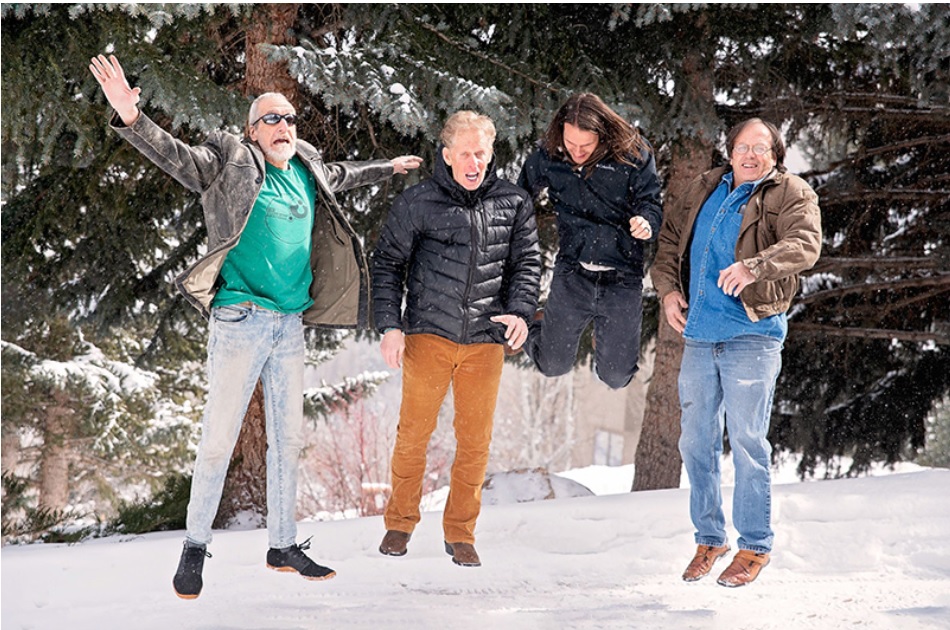
Carter & the Capitals are a high energy five-piece funk group from Edmonton, Alberta. Known for their signature, hard-driving sound, soulful vocals, and catchy instrumental riffs, the Capitals fuse the most danceable elements of the pop and funk genres. By bottling up deep grooves from their wide range of influences and combining them with tight, snappy arrangements, the band offers its own unique take on Western Canadian funk.
Following up on their 2019 self-titled debut album, Carter & the Capitals return with “Lovely Lovely Lovely,” a joyful new track that serves as a reminder for the band to not take themselves so seriously and to enjoy the privilege of playing music with some of their best friends. With lots of growing pains and mistakes over the past years, the Capitals have become closer while making the best music they’ve ever made.
Saint-Sauveur, Québec’s borza is sharing a new release entitled “As high as you can go,” dedicated to reminding listeners that an abundance of love is possible, so it’s worth taking chances.
The track began as a folk song before morphing into the distorted guitars and sweet harmonies of the finished song, creating an energetic and uplifting number meant to elicit excitement in ourselves.
Love can be the energy that propels us forward and allows us to move through nervousness, opening up life changing possibilities.
“Take all the love in your way and grow as high as you can go.”
On his third solo album, the self-produced Papercut—armed with a couple lifetimes of songwriting and touring in his rear view mirror—Carleton Stone gets honest about the toll of devotion to craft while illustrating his mastery of it. Through sax-blasted Americana, power-pop laced with ‘80s synth, and dreamy, sophisticated pop melodies, the Nova Scotia songwriter blurs genres to explore a tumultuous few years and some of the scariest questions someone can ask: “What the hell have I done? What if I’d gone down some other path?”
His new song, “House in the Hills” encapsulates the feeling of accepting that we are enough with what we have in our lives. It feels like the media or internet is always trying to sell us something to help improve our lives or make us feel like we aren’t enough, and Carleton Stone is trying to counterbalance that feeling with this song.
With this song, Carleton really wanted the lyrics and the message of the song to stand out so he kept the production as simple as possible with just enough to help support the story. When the song was written in early 2020, the pandemic wasn’t even a thing that was on most people’s radar at that point. The pandemic only highlighted the feelings in the chorus of this song and reminded us what is truly essential in our lives.
“We wrote this song in the first few days of 2020,” says Carleton. “I remember waking up and checking Instagram and seeing that the U.S. had assassinated a general in Iran and thought ‘Oh wow, this doesn’t seem good,’ and then scrolled down and saw the next piece of news was that Post Malone had got a new face tattoo. I thought the juxtaposition of these two stories encapsulated so much of what is wrong with the ‘click-bait’ world we live in.”
For the band, writing music is a very therapeutic experience. They try to write songs about the things they are struggling with, and mix them with fun upbeat melodies as a good way to blow off some steam and gain some perspective.
Their reflective song, “Devils Working Late,” was inspired by singer Greg Chomut (a.k.a. Luke Warm) and his experience with becoming a father. It was a major transition for him to have everything revolve around caring for somewhere else.
It’s a common feeling to miss going out with your friends and just having fun, especially in the early days of being a parent. Even though Greg loves his children and family deeply, he found that on the rare occasion that he got a chance to go out with friends, he would try to make it last as long as possible – staying out way too late and usually not getting home until the next morning. He would feel really bad about it after, thinking that there was something wrong with him, but he realized it’s probably a pretty normal feeling after such a big change.
The song is basically saying to listeners, “So this wasn’t your best day. Don’t beat yourself up. It’s just part of life.” Hopefully people can associate with the lyrics and if they know the feeling it can give them a little comfort.
Jazz vocalist and songwriter Eva Schubert is a fresh new voice, whose sound blends seamlessly with the classic style of jazz greats like Helen Mirrell, Peggy Lee, and Nat King Cole.
Her fourth album, The Feel of Your Love, is a sultry, hypnotic collection of songs that effortlessly shift the colour of your mood. Beautiful piano stylings, guitar riffs and saxophone grooves mix classic jazz sounds with a distinctly modern sonic palette.
Eva was inspired to write the wistful and haunting “Dark Star” one summer evening when she was walking in the park and heard a man singing in a distinctly Latin style. As she walked on, a few of those notes began echoing in her mind, and she started adding to them.
However, when she brought this song to her producer, he wasn’t really sure how to arrange it. They ended up heading into the studio without any rough arrangement prepared, though they had sketches of all the other songs on the album. Eva just walked up to the mic and sang the lyrics a capella in the studio, for the other musicians. There was complete silence.
Then, when she sang it again, they started to play along… And right there the song blossomed in front of them, like a flower emerging from the soil and maturing in mere minutes.
Lenni Revel’s story begins the way most fairytales end: Big A&R professionals vying for her music, Grammy nominations, and billboards in Times Square promoting her music. But her pop dream ended when she was kicking Adderall cold turkey in a shed outside of her parent’s house and plunged into such darkness that she was eventually admitted to a psych ward and put on suicide watch. Her upcoming album, Unbroken, is about her rebirth and reclamation from the clutches of mental health struggles, drugs, and the music business machine. Unbroken also embodies a profound love story between Lenni and her husband, Robert Revel, a family lawyer and critically-acclaimed author who wrote and co-wrote much of the album.
Her video for her latest outlaw country-esque and pop-rock infused single “Where There Ain’t No Sun” conceptualizes pain and loss. While Lenni’s voice is powerful on it’s own, the imagery of a cemetery really drives home the emotional aspect of the song. What really drives the video home is when Lenni releases ashes at the top of a hill at the climax of the song. It’s chilling, haunting, and mesmerizing. She’s symbolically letting go, releasing herself from the pain.
We spoke with Lenni about the music video:
Tell us the story of this song, why did you choose to visualize this song specifically in this way?
The cemetery in the video is a beautiful old site where the founders of the city are buried. It is a favorite walking path of many locals, including Robert and I. The Mausoleum is also on the cemetery site, and we were granted access by a kindly groundskeeper to shoot the interior scenes depicted in the video. The hilltop scene, where the urn ceremony occurs, is another hiking favorite locale of ours. We imagined that one day we would shoot some kind of music video on the spot because of its beauty.
What was the inspiration behind this video?
The song, “Where There Ain’t No Sun” was originally written about unrequited love. I evolved the song’s vocal melodies and facilitated structural and lyrical changes to accommodate my interpretation of the song as being fundamentally about deep loss and grief. My version brought the visual application of the music to images of death, but painted delicately and beautifully with a performance with heart and soul right at the center of it.
What was the process of making this video?
Once the cemetery location was chosen, the time of year to shoot there became an important element; we wanted to capture the beautiful lush green grasses and mosses that grow there in the spring—new life emerging from death. We shot the graveyard scenes in March and soon after we shot the mausoleum scene at the same location. Our dog “Kota” (she is a pure-bred Thai Ridgeback) was utilized in the gravestone shots as an element representing the haunting aspects of grief and the unseen but ever-watching spirit world. Kota, as a recurring element has subsequently made appearances in every music video I’ve performed in. The ceramic urn used for the ashes has special value to Robert, as it is the gift of his best friend who passed away in his fifties. The drone shots on top of the mountain were shot by a local drone pilot who typically shoots for real estate clientele. We had to shoot the ash ceremony quickly as the sun was setting and we had only a few-minute window to gather all the footage.
You must be logged in to post a comment.