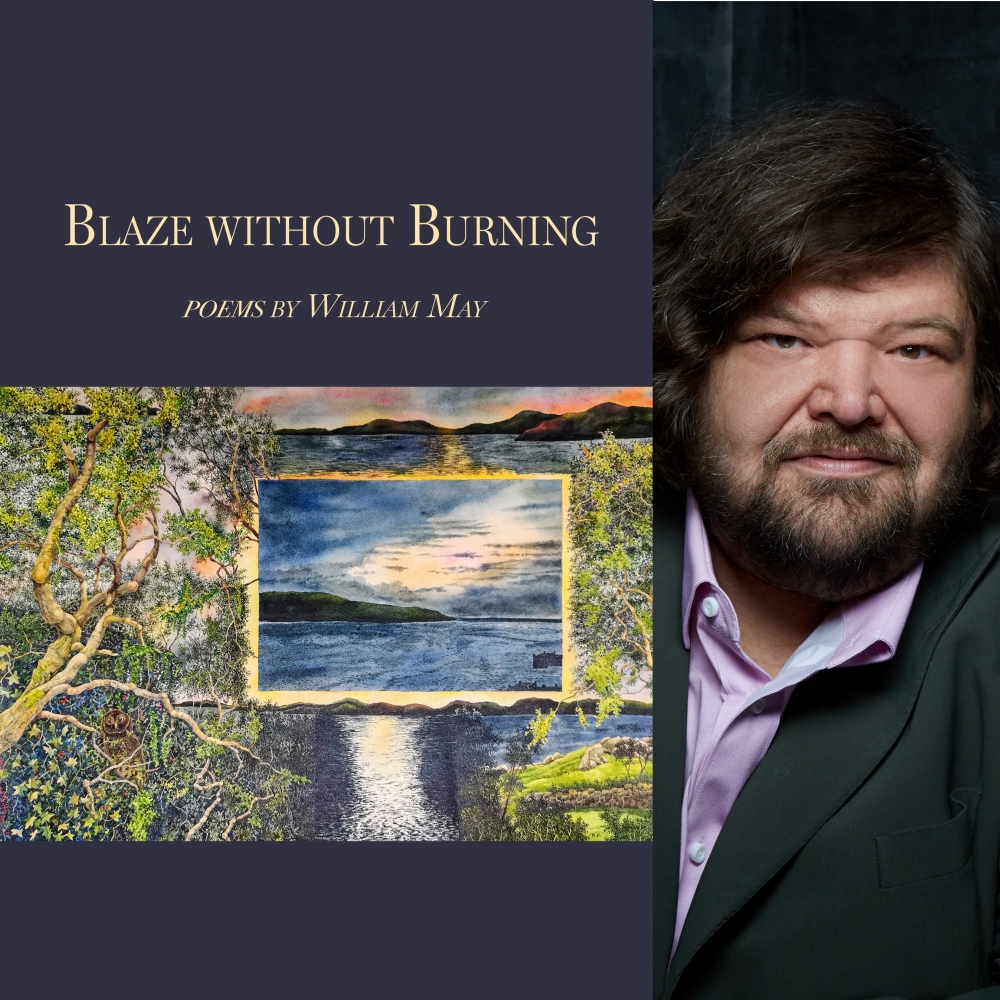
William May’s debut chapbook, Blaze Without Burning (Finishing Line Press, May 30, 2025), announces the arrival of a poet interested less in certainty than in reflection, revision, and the quiet instability of meaning. Structured around a striking mirrored design, the collection pairs each early poem with a later counterpart, creating a built-in act of return. What emerges is not repetition, but reinterpretation—an evolving conversation between versions of the self, where memory, language, and feeling are never quite fixed.
The “twin poem” structure is the book’s defining gesture, and it feels less like formal experimentation than philosophical inquiry. Each pairing resists the idea that a poem can ever fully resolve itself on first encounter. Instead, May builds a space where the reader is asked to reconsider what they thought they understood, to sit with the discomfort and clarity that come from seeing the same emotional terrain from a shifted angle. The effect is cumulative: meanings accrue, fracture, and reform across the book’s mirrored halves.
At the center of this formal design is a voice that is intimate without being confessional in a conventional sense. May writes with a restraint that allows emotion to surface indirectly, often through detail rather than declaration. Childhood moments, fragments of family life, and instances of private recognition appear with quiet force, never overstated but carefully held. The poems feel attentive to the small architecture of experience—the way a single image or memory can carry disproportionate emotional weight.
May’s personal history informs the work in subtle but resonant ways. Diagnosed as neurodivergent at a young age, he has spoken about early struggles with reading and the long arc from perceived limitation to creative fluency. That trajectory is not foregrounded in the poems as explanation, but it hums beneath them as an ethic of attention: a sense that language is something earned slowly, precisely, and with care. The result is writing that often feels both hard-won and deeply deliberate.
The title Blaze Without Burning captures the book’s central tension: intensity without destruction, transformation without collapse. Across the collection, emotional heat is present but controlled, even elegiac. May is interested in what it means to feel deeply without being consumed by feeling, and his poems often linger in that charged middle space where clarity and ambiguity coexist.
Form and content are matched by an understated visual sensibility. The chapbook’s cover, featuring a watercolor work by Richard Frank (1947–2014), extends the book’s preoccupation with layering and perception. Frank’s dreamlike imagery complements the poems’ tonal balance—suggesting surfaces that hold depth beneath them, and images that shift depending on how long they are observed.
May’s path to publication adds another dimension to the work without overshadowing it. A lifelong New Yorker from Greenwich Village, he began writing poetry in childhood and continued through specialized educational support that helped shape his relationship to language. He later studied at institutions including Sarah Lawrence College and completed an MFA at the University of North Carolina. Alongside his writing, he hosts Argh! Not Another Book Publishing Podcast, where he explores the realities of the literary world with candor and curiosity.
Ultimately, Blaze Without Burning is a debut defined by its patience and precision. It resists urgency in favor of return, asking readers to come back again and again, each time with slightly altered understanding. In doing so, William May offers a collection that is less about arriving at meaning than about learning how meaning continues to shift after arrival.
Purchase the book here: https://williammaywrites.wordpress.com/blaze-without-burning/

