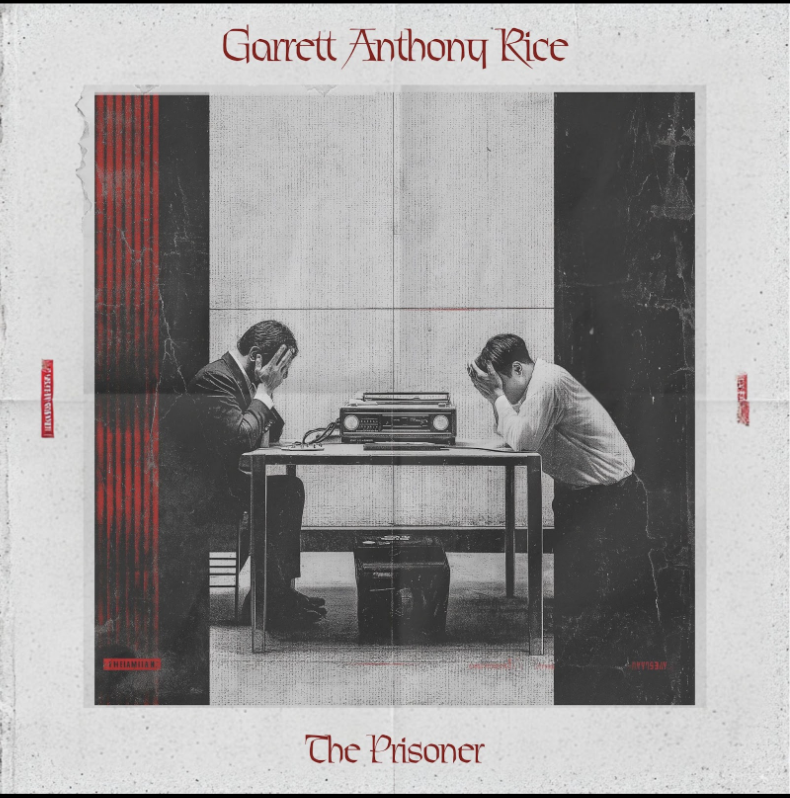
GARRETT ANTHONY RICE UNVEILS “THE PRISONER,” A TAUT AND UNSETTLING PREVIEW OF UPCOMING DOUBLE ALBUM EQUINOX

Garrett Anthony Rice continues the slow-burn reveal of his forthcoming double album Equinox with the release of his latest single, “The Prisoner,” a tightly wound piece of narrative songwriting that plays with tension, confession, and illusion. Arriving as another carefully placed fragment of the larger project, the track stands confidently on its own while deepening the emotional and conceptual framework of the album.

Built on restraint, “The Prisoner” unfolds with deliberate patience. Its verses move in controlled, measured breaths, creating the feeling of someone speaking under pressure, circling a story rather than confronting it head-on. The atmosphere is claustrophobic and monochrome, with Rice holding back melody and release, letting silence and space do as much storytelling as the words themselves. There is a subtle musical nod to the unease of classic rock suspense, recalling the creeping dread of The Rolling Stones’ “Gimme Shelter,” while remaining firmly grounded in Rice’s own stark, modern sensibility.

When the chorus finally opens, it feels like a confession breaking through restraint, the moment where melody and arrangement briefly expand before snapping back into control. It is a familiar emotional move for fans of great rock storytellers, but Rice executes it with quiet confidence and precision. The tension peaks in the closing lines, where the narrative dissolves with the admission, “I must confess I made this up,” reframing everything that came before it. The line lands with sly disorientation, echoing the tradition of late-song revelations that collapse the boundary between fiction and truth.

Rather than leaning on nostalgia, “The Prisoner” treats influence as something to be absorbed and reshaped. Rice is less interested in revival than in conversation, using the lineage of classic rock storytelling as raw material for something more introspective and psychologically complex. The result is a track that feels both familiar and quietly subversive, grounded in craft, intention, and emotional depth.

As part of Equinox, an 18-song double album that follows Rice’s 2023 debut under the alias (i) CONSULT, “The Prisoner” signals an artist fully committed to ambition and detail. Recorded across Ireland and the UK with producer Chris Potter, whose past collaborations include The Rolling Stones, Paul McCartney, U2, and Richard Ashcroft, the album has already drawn significant praise from industry figures who have heard early versions. If “The Prisoner” is any indication, Equinox is shaping up to be a project defined not by immediacy or trend, but by patience, narrative complexity, and emotional resonance.

With this release, Rice continues to position himself as a storyteller deeply invested in tension, nuance, and the spaces between certainty and doubt. “The Prisoner” doesn’t offer easy answers or tidy resolutions. Instead, it lingers, unsettles, and invites repeat listens, marking another compelling step toward the arrival of Equinox.

TubeFreeks and Clint Lowery Strike Gold on Explosive New Track “Flower”

TubeFreeks return with “Flower,” a gripping new single co-written with Sevendust guitarist Clint Lowery that blends muscular hard rock with modern melodic tension. The Frederick, Maryland band lean into thick guitars, dynamic rhythms, and a vocal performance that balances grit with emotional clarity. The result is a track that feels heavy without being rigid, melodic without softening its edge.

“Flower” moves with urgency, anchored by restless drums and tightly locked guitar work that gives the verses a simmering momentum. When the chorus hits, the song opens up, trading tension for release in a way that feels deliberate and earned. Frontman Paul van Valkenburgh delivers a performance that is both raw and precise, bringing emotional weight without sacrificing power.

The collaboration with Lowery adds a familiar sense of structure and polish while allowing TubeFreeks to remain firmly themselves. The songwriting never drifts into nostalgia, instead channeling the spirit of post-grunge through a modern production lens that keeps the track grounded in the present.

Paired with a striking music video directed by filmmaker Tom Flynn, “Flower” expands its emotional range even further. Saturated gold tones and natural landscapes frame a visual narrative built around longing, distance, and pursuit, echoing the song’s lyrical themes.

With major tour dates on the horizon and a growing national presence, TubeFreeks continue to sharpen their identity. “Flower” stands as one of their strongest releases yet, capturing both their intensity and their evolving artistic depth.

A Dreamlike Debut: Saul Damelyn’s “Museum of Love” Lyric Video

Saul Damelyn’s “Museum of Love” arrives as a quietly arresting debut single on British indie label Damelyn Records. From the first notes, the song sets a reflective tone, pairing lyrical sophistication with melodic nuance. The accompanying lyric video, created by painter and animator Vanessa Brassey, elevates the music into a fully immersive visual journey.

Set within a conceptual Museum of Love, the video unfolds as a wandering exploration of memory and connection. Figures drift through galleries, their movement mirroring the song’s thematic exploration of emotional landscapes. Each room presents a new layer of feeling—desire, devotion, curiosity, quiet reflection—turning the museum into both a literal and metaphorical space. Phoebe White’s ethereal presence appears intermittently, enhancing the dreamlike sensibility and suggesting the presence of memories that are felt more than seen.

Brassey’s approach to animation is tactile and painterly, resisting the slickness of digital media to create warmth and texture. Her grounding in philosophy and fine art informs the project’s depth, ensuring the visual storytelling mirrors the song’s introspective qualities. Moments in the video often linger, allowing viewers to reflect alongside the characters as they navigate spaces that are as much psychological as physical.

Musically, the track is structured as a conversational duet between Damelyn and White, with production by Paul A. Harvey and Tom Robinson. The song conveys a dialogue between two people navigating the remnants of a shared past, balancing lyrical intelligence with melodic appeal. “Museum of Love” is reflective without being heavy-handed and memorable without feeling poppy or insubstantial.

The song’s influences are wide-ranging yet subtly integrated. English new wave lyricism reminiscent of Elvis Costello and The Kinks sits alongside hints of Americana storytelling in the tradition of Lucinda Williams and Richard Thompson. The result is a sound that feels lived-in, timeless, and emotionally immediate, providing a rich canvas for Brassey’s animated lyric video.

As the lead single from the forthcoming album Kings, Queens and Dream Machines, “Museum of Love” positions Saul Damelyn as a songwriter capable of transforming personal introspection into work that resonates broadly. The lyric video extends that artistry, offering a visual world that rewards close observation and repeated engagement.

Ultimately, “Museum of Love” is a debut that bridges music and visual art, creating an experience that is both intimate and expansive. It demonstrates a rare capacity for emotional clarity in songwriting, and its video invites audiences to step into a space where memory, longing, and human connection are rendered with nuance, warmth, and cinematic grace.

Matt Alter Keeps It Real on “Train to Nowhere”

Mattalter copy

“Train to Nowhere” is a song that moves with purpose, one that understands the weight of its own narrative without overdoing it. From the opening intro, Matt Alter manages to balance reflection and momentum in a way that is deliberate and effortless. And it’s a track that is built on experience.

Sound wise, there is a familiar warmth here for anyone who remembers Technicolor from Race to the Finish. The guitars glide with understated polish, the rhythm section keeps a quiet tension humming beneath the surface and Alter’s vocals have that this lived in quality he has always had.

Lyrically, the song navigates that strange, uneasy space between forward motion and uncertainty. It’s about being on a train and not fully knowing the destination, about the moments when life keeps moving even when clarity feels far away. Here, Alter simply presents this feeling, and it is enough. It is this honesty which he pairs witih exacting musical choices that makes the track a welcome addition to your playlist.

From the forthcoming album I’m Lonely… It’s My Fault, which drops beginning of March, Matt Later promises a record that will continue to explore personal and introspective terrain. “Train to Nowhere” is one of those tracks that is a natural evolution of Matt Alter’s songwriting voice, both for longtime listeners and new fans alike.

About Matt Alter

Based in North Carolina, Matt Alter is a singer songwriter who layers melodic rock with personal themes.

After years of balancing a demanding medical career with his passion for music, Alter returned to songwriting with renewed focus, releasing a steady run of solo albums including The Bitter Pill, Race to the Finish, and Did I Offend You?, the latter produced by Tavis Stanley of Art of Dying.

His work is shaped by real life experience and a commitment to craftsmanship, resulting in songs that are grounded and authentic but which also demonstrate skilled musicianship. With his upcoming album I’m Lonely… It’s My Fault, Alter continues to refine his voice as a songwriter.

Find out more on the Website

Stream music on Spotify and Apple Music

Dylan De Braga Turns Heartache Into Power on New Single “Hold The Door”

Like a lone flower pushing its way through the ashes of a forest long since burned, Dylan De Braga’s debut single, “Hold The Door,” rises quietly from devastation into something achingly beautiful. Born from one of the most traumatic chapters of his life, the folk-inflected ballad transforms pain into clarity, standing not as a monument to suffering, but as proof that something delicate, resilient, and luminous can emerge in its wake.

Written in the aftermath of a brutal, heart-shattering breakup, De Braga found himself unable to even touch his guitar for nearly two months. Music, once his anchor, felt suddenly unreachable. When he finally found the courage to sit alone with his emotions and pick up his guitar again, the song seemed to arrive fully formed.

“‘Hold The Door’ wasn’t written, it arrived,” he says. “Within minutes, the chords and words surfaced exactly as they needed to, as if they had been waiting for me to be ready. It felt like the first breath after being underwater for too long.”

Crafted in the heart of Manhattan, “Hold The Door” was recorded alongside Grammy Awardwinning producer Chris Sclafani (Ed Sheeran). Shaped by the intensity, energy, and creative spirit of New York City, the track evolved into an expansive and immersive production. Every layer reflects a careful balance of vulnerability and power, allowing De Braga’s raw vocal performance to carry both grief and resolve.

“Without ‘Hold The Door,’ I wouldn’t be where I am today, and I wouldn’t be the person I’ve grown into,” De Braga confesses. “It will always hold a sacred place in my heart; it didn’t just come from pain, it pulled me out of it.”

Greg Boyer Reflects Without Regret on New Single “Perfectly Gone”

Veteran songwriter Greg Boyer shares “Perfectly Gone,” a spare, thoughtful folk-pop reflection shaped by restraint, atmosphere, and emotional economy. Inspired by a breakup and written during a period immersed in rockabilly and folk influences, the track feels less like a lament and more like a moment of calm acceptance; an acknowledgement rather than a reckoning.

“There’s no big story behind the title,” Boyer says simply. “The two words worked well together.” That same directness defines the song itself. Built around repetition rather than escalation, “Perfectly Gone” uses its title as a subtle anchor; a quiet hook that reinforces the song’s emotional stillness rather than pushing toward resolution.

The track’s journey to release was anything but immediate. Written years ago and buried in a forgotten folder, “Perfectly Gone” resurfaced almost by accident. “I had completely forgotten about it,” Boyer recalls. “It was rejuvenated in two takes, and now it’s one of my favourites.” That rediscovery lends the song an added sense of distance and perspective; a reflection viewed through time rather than raw immediacy.

Producer Malcolm Burn helped shape the song’s understated mood, choosing an atmospheric palette that mirrors its emotional clarity. A lap steel guitar provides a restrained, open-ended solo, reinforcing the song’s dreamlike calm rather than interrupting it. Boyer’s lyricism remains intentionally minimal, leaning on images instead of narrative detail. As Terri Thal (Bob Dylan’s first manager) once remarked after hearing the track, it’s “an acknowledgement, not a mourning… and it doesn’t go into interminable detail.”

Measured, emotional, and quietly resolute, “Perfectly Gone” resists over-explanation. It sits comfortably in the space between feeling and release; brief by design, and all the stronger for it.