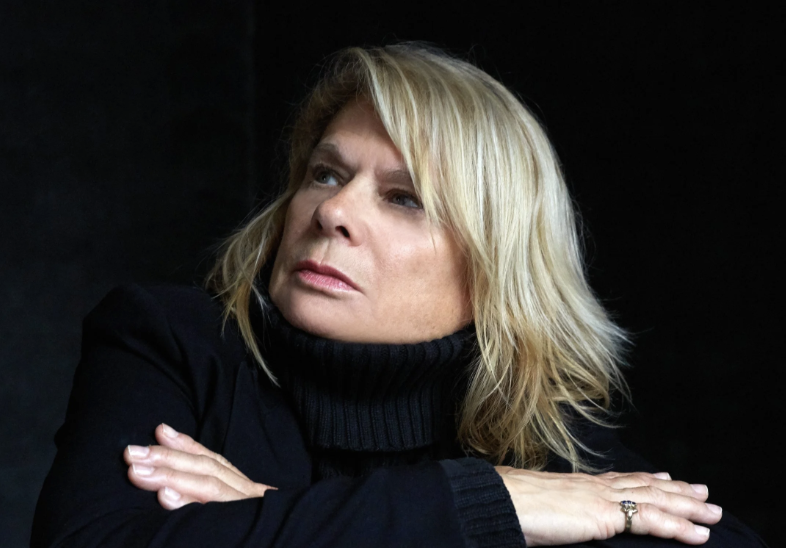
Every once in a while, a record arrives that doesn’t just play—it confronts. It grabs you by the collar, drags you into its private world, and dares you to stay there. Mifarma, the first English-language album from Danielle Alma Ravitzki’s alter ego of the same name, is that kind of record: bruised, luminous, unrelenting. It’s not an album you casually put on in the background—it’s one you walk through, barefoot and cautious, knowing something inside it might rearrange you.
Ravitzki, who first made her name in the Hebrew music scene with a pair of haunting, poetically driven records in 2013 and 2017, has built a reputation on blending the cerebral with the visceral. But Mifarma is something different entirely. It’s not just a new chapter; it’s a new language, a new country, a new skin. Where her earlier work borrowed the voices of poets, Mifarma is entirely her own—a document of reclamation, written in scars and whispered prayers.
The story of the record’s creation is the kind that feels mythic in hindsight. After relocating to New York, Ravitzki found herself in a state of artistic paralysis, unable to find a producer who understood the sound in her head: part confession, part dream, part ache. It wasn’t until she remembered an old Berlin album that featured drummer Earl Harvin that she stumbled onto Carmen Rizzo, the two-time Grammy nominee whose résumé spans from electronic pioneers to ethereal singer-songwriters. Their collaboration became the album’s backbone—Rizzo providing the space and tension, Mifarma filling it with blood and breath.
The opening single, “I Left the Room Without My Hair,” co-written with Shara Nova of My Brightest Diamond, sets the tone like a ritual. The title alone is a line of poetry—a disarming image of leaving behind an old self, or maybe escaping one. The song builds slowly, like a fever dream; the arrangement is sparse but suffocating, a whisper pressed against your ear. It feels less like listening and more like eavesdropping on someone’s internal reckoning.
From there, Mifarma unfolds like a series of journal entries written during a long night of the soul. “Five Stages of Grief” is all sharp angles and soft collapses, a song that keeps returning to its wounds just to see if they’ve closed. “Fix Me Up” rides a pulse somewhere between resignation and defiance, its minimalist beat giving way to a fragile chorus that feels like a hand reaching through fog. On “I Am Soil,” Ravitzki sings with the slow, deliberate weight of someone who has learned to make peace with impermanence—her voice a tremor wrapped around a threadbare melody.
Rizzo’s production gives these songs their atmosphere: intimate but vast, unhurried but never still. He builds soundscapes that seem to inhale and exhale with Mifarma’s vocals, fusing the human and the mechanical. There are shades of Kate Bush, echoes of Peter Gabriel, and a touch of Laurie Anderson in how Mifarma treats sound as both story and character. Yet there’s nothing derivative about it. Every note feels born of its own strange gravity.
The album’s supporting players add color and contour without ever stealing focus. Harvin’s drumming is restrained but surgical, creating tension where silence would otherwise fall flat. Nova’s harmonies are ghostlike—present, then gone, like a flicker of candlelight in a darkened room. Melissa Lingo and Piers Faccini contribute in subtler ways, adding texture to a record that feels at once global and deeply personal. It’s a sound that could have been born in Tel Aviv or Brooklyn or nowhere at all.
What’s remarkable about Mifarma is how unflinching it is. These songs don’t tidy up their emotions for the sake of accessibility; they linger in the mess, tracing the contours of pain, shame, and rebirth with brutal honesty. “Rejection is My Pendant” is as much about obsession as liberation—a slow, hypnotic waltz that flirts with self-destruction before finally exhaling into stillness. “Somnambulist” plays like a dream within a dream, its delicate rhythm pushing against the edges of consciousness.
And yet, for all its darkness, Mifarma isn’t despairing. There’s a quiet resilience that pulses beneath the sorrow, a reminder that vulnerability isn’t the opposite of strength—it’s the root of it. Ravitzki’s voice, fragile and deliberate, often sounds as though it’s holding back tears—but when it breaks free, it’s incandescent.
By the album’s end, you get the sense that Mifarma isn’t just an alter ego—it’s a vessel, a place where Ravitzki can speak freely without translation. There’s something profoundly timeless about the way she approaches melody and meaning, as if she’s communing with the ghosts of the great confessional songwriters before her—Joni Mitchell, Beth Gibbons, Jeff Buckley—while still charting her own territory.
Mifarma doesn’t chase trends or polish itself for commercial appeal. It belongs to an older tradition: albums as complete worlds, meant to be lived in from start to finish. It’s the kind of record you return to late at night, headphones on, when the rest of the world feels far away.
By the time the final notes fade, you don’t feel like you’ve just listened to music—you feel like you’ve been somewhere. Somewhere lonely, somewhere honest, somewhere sacred.


You must be logged in to post a comment.