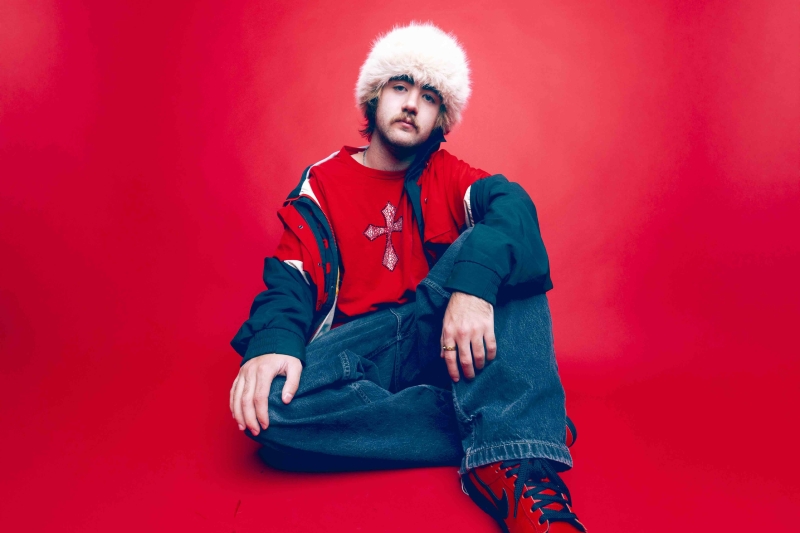
With rugged honesty and a dose of youthful defiance, Rogan Mei returns with “Rushmore (So What),” an angsty and liberating folk-rock anthem about missed chances, restless energy, and carving your own road. Louder and more unapologetic than his earlier reflective work, the track captures the friction between wanting change and actually living it – set against ringing guitars and a chorus built to be shouted back.
The song’s title traces back to an unfinished idea that sat dormant for years. “Originally, it was going to be about a road trip with friends where the main character was just not in a good headspace and would sleep in the back seat while everyone pointed out monuments like the biggest hockey stick in the world, the Grand Canyon, or Mt. Rushmore. That’s where the line ‘So what I didn’t see Mt. Rushmore’ came from,” says Mei. Though the story shifted, that core lyric survived and became the heart of the new track.
Unlike his last release “Lefroy,” which emerged in just a few days, “Rushmore (So What)” simmered for years before coming to life. Brought to a songwriting workshop in 2024, Mei dusted off the fragments with the encouragement of collaborator Anna Goldsmith, who helped him reconnect with the song’s raw energy. With support from bassist and mixing engineer Wesley Covey and the full band, the track evolved into one of the most anthemic highlights from his upcoming Dickies Green Plaid Jacket EP.
Dallas singer, songwriter, multi-instrumentalist, and producer Julian Maas steps confidently into the spotlight with his debut album, Cherry, released today, October 17th. The record arrives as both an intimate self-portrait and an invitation—an open-ended collection of songs that allow space for listeners to bring their own interpretations. In its 10 tracks, Cherry navigates confusion, hate, death, peace, and love, themes universal in scope yet filtered through Maas’ distinct sensibility as an artist who refuses to settle into one sound or emotion.
At just twenty-one, Maas demonstrates a creative depth and patience well beyond his years. Cherry doesn’t strive to provide answers; rather, it documents the process of searching—musically and emotionally. The record feels like a living map of his influences, a sprawling synthesis of three decades of alternative and electronic music. There are threads of Helmet, Pinback, Grauzone, The Lilys, Placebo, Sneaker Pimps, Veruca Salt, Crystal Method, and Supercar woven throughout the album’s fabric, yet the end result is distinctly his own. The fusion of these references never feels derivative; instead, Maas reimagines them into a forward-looking soundscape that’s as atmospheric as it is deliberate.
During the writing process, Maas immersed himself in music constantly—on walks to class, during lunch breaks, and in the in-between moments that fill a day. The result is a record that feels lived-in, reflecting both the restlessness and focus of an artist shaping his voice through immersion rather than imitation. His recent listening habits, from rediscovering Rocket to reminiscing about the chaotic spirit of Warped Tour, suggest that this album is less a culmination and more a foundation for what’s to come.
What makes Cherry stand out is not only the breadth of its sound but the intimacy of its creation. Maas is known for his refusal to repeat himself; each project he approaches as a fresh experiment in tone and emotion. His songwriting process often begins with the music itself—instinctual, raw, and exploratory—before lyrics emerge in spontaneous bursts. Many of these songs lived as instrumentals for months or even years before finding their full lyrical form, a process that gives them a layered, time-worn depth.
Equally striking is Maas’ self-sufficiency as a producer. Entirely self-taught, he records and arranges his own material, layering sound with an understanding of texture that comes from both obsession and intuition. That hands-on approach translates powerfully to his live performances, where he has shared stages with acts such as Tripping Daisy, bringing complex arrangements to life with little more than his instruments and voice.
Beyond Cherry, Maas’ growing discography provides a fuller view of his evolving artistry. Projects like Isolate (released May 12, 2025) and earlier works from 2021 to 2024 trace his shifting interests and creative questions. Whether he’s reflecting on artificial intelligence and its impact on human experience, probing political systems, or charting the delicate territory of personal relationships, his music remains grounded in a core honesty. What binds these works together is not a singular sound but a consistent curiosity—a drive to understand and express without pretense.
Cherry positions Julian Maas squarely within the contemporary rock landscape while hinting at the fluidity that defines his next chapter. The track “Did You Ever Think” captures that balance perfectly: a song crafted for the album but standing powerfully on its own, embodying solitude, reflection, and the quiet resonance of being heard. It’s emblematic of the record’s understated confidence and emotional precision.
Through Cherry, Maas doesn’t just offer a debut; he offers a philosophy of creation. It’s music built on instinct and reflection, an album that feels like a conversation between artist and listener—one that doesn’t demand to be understood fully, only felt. In doing so, Julian Maas establishes himself as an artist guided not by genre or trend, but by the deeper pursuit of connection through sound, story, and truth.
Toronto’s own ONE HUNDRED MOONS returns with “The Architect”, the latest single from their forthcoming album Black Avalanche—a track that fuses the haunting elegance of shoegaze with the weight of existential reflection. The song unfolds like an act of creation and destruction, capturing the essence of the band’s sound: immersive, unsettling, and achingly beautiful.
From its first notes, “The Architect” sets a tone of dark reverence. A low, resonant bass line pulses beneath drifting guitar textures, gradually giving rise to a sonic landscape that feels vast and cinematic. The track moves with purpose, building momentum through layers of distortion and echo before reaching a cathartic breaking point. When the music suddenly falls away, silence becomes its own statement—a breathless aftermath to the storm that came before.
Beneath the track’s hypnotic surface lies a deeply introspective core. The lyrics probe ideas of personal agency and self-created pressure, capturing the tension between control and chaos. Originally sparked by a stream of consciousness meditation on the absence of divine authority, the song evolved into an exploration of overthinking and the consequences of living entirely within one’s own mental architecture. Retaining the title “The Architect” became symbolic: a declaration that we are both the builders and the prisoners of our own design.
The song’s sound mirrors this internal conflict. Every swelling chord, every whisper of feedback, feels like a structural element in a collapsing cathedral. The band balances dissonance and melody with precision, crafting a piece that’s as emotionally arresting as it is sonically intricate. It’s an experience meant to be felt as much as heard.
With “The Architect”, ONE HUNDRED MOONS continues to blur the boundaries between shoegaze, post-rock, and alt-rock. The group—Collin Young, Jen Vella, Justin Hunt, Matt Laplante, and NJ Borreta—weaves together influences from My Bloody Valentine, Radiohead, and Slowdive while maintaining a distinctly modern voice. Their compositions blend the dreamlike haze of classic shoegaze with the cinematic sweep of post-rock, grounding everything in raw emotional honesty.
What sets ONE HUNDRED MOONS apart is their commitment to atmosphere. They don’t just play songs—they build environments. Their sound feels alive, filled with movement and shadow, and “The Architect” stands as a perfect example of that craft. The track captures both the vastness of introspection and the intimacy of self-confrontation, pulling the listener into an otherworldly space where thought and emotion collide.
The release arrives as the band continues their fall Ontario tour, bringing their expansive sound to stages in Waterloo, Oshawa, Niagara, Toronto, Hamilton, and Windsor. Known for transforming live shows into immersive, multi-sensory experiences, ONE HUNDRED MOONS translates their lush, studio-born textures into walls of sound that surround the audience completely. Each performance feels like a shared emotional voyage—a moment suspended between light and noise.
“The Architect” offers a striking preview of what’s to come on Black Avalanche, an album that delves deeper into the interplay between tension, mood, and melody. If this single is any indication, listeners can expect an ambitious, emotionally charged collection that challenges the boundaries of what shoegaze can be.
With this latest release, ONE HUNDRED MOONS doesn’t just reaffirm their position as one of Toronto’s most exciting emerging acts—they invite us to reconsider the structures we build within ourselves. “The Architect” is more than a song; it’s a mirror held up to the mind, reflecting both the fragility and the strength that come from creating your own world.
Capping off back-to-back weekends of fundraising and community building, APLA Health once again brought Los Angeles together in spectacular fashion with the 2025 Best in Drag Show, held Sunday, October 5 at the historic Orpheum Theatre in Downtown LA.
Following the success of last weekend’s 41st annual AIDS Walk Los Angeles, thousands filled the Orpheum for an unforgettable night of comedy, camp, and compassion — all in support of APLA Health’s Alliance for Housing & Healing program, which provides critical services and housing for people living with HIV across Los Angeles County.
Hosted by a team of dedicated volunteers and emceed by beloved drag talent Salina EsTitties—who began her drag career on this very stage—the show delivered an over-the-top pageant parody where contestants competed in talent, costume, and interview categories. Audiences cheered as the performers dazzled with jaw-dropping looks and outrageous performances, each moment celebrating the creativity and defiance that define LA’s drag legacy.
The star-studded judging panel included 2025 Emmy Award winner Katherine LaNasa, Judy Greer, Camryn Manheim, Cheri Oteri, Dan Bucatinsky, Grant Show, Kathy Kinney, and Variety’sMarc Malkin, who lent wit and enthusiasm to a night full of laughter and heartfelt appreciation for the cause.
“Best in Drag Show isn’t just a night of glitter and glamour—it’s a statement of inclusion, empowerment, and communal strength,” said Terry D. Goddard II, Director of the Alliance for Housing & Healing. “Every performance and costume reflects the creativity, courage, and resilience of our community.”
Now in its third decade, Best in Drag Show has grown from a small fundraiser in a West Hollywood living room into one of LA’s most beloved annual events. Each year, it raises vital funds for APLA Health’s HIV and housing programs while fostering visibility and solidarity for the LGBTQ+ community.
“Events like Best in Drag Show and AIDS Walk LA remind us of the power of collective joy and action,” said Craig E. Thompson, CEO of APLA Health. “They’re more than fundraisers—they’re celebrations of who we are, and what we can achieve together.”
As the curtain closed on another sold-out evening, the message was clear: LA shows up for its community. From the sidewalks of West Hollywood to the stage of the Orpheum Theatre, APLA Health continues to unite Angelenos around creativity, compassion, and care—proving that when art and advocacy meet, everyone wins.
For more information on APLA Health and upcoming events, visit aplahealth.orgCapping off back-to-back weekends of fundraising and community building, APLA Health once again brought Los Angeles together in spectacular fashion with the 2025 Best in Drag Show, held Sunday, October 5 at the historic Orpheum Theatre in Downtown LA.
Following the success of last weekend’s 41st annual AIDS Walk Los Angeles, thousands filled the Orpheum for an unforgettable night of comedy, camp, and compassion — all in support of APLA Health’s Alliance for Housing & Healing program, which provides critical services and housing for people living with HIV across Los Angeles County.
Hosted by a team of dedicated volunteers and emceed by beloved drag talent Salina EsTitties—who began her drag career on this very stage—the show delivered an over-the-top pageant parody where contestants competed in talent, costume, and interview categories. Audiences cheered as the performers dazzled with jaw-dropping looks and outrageous performances, each moment celebrating the creativity and defiance that define LA’s drag legacy.
The star-studded judging panel included 2025 Emmy Award winner Katherine LaNasa, Judy Greer, Camryn Manheim, Cheri Oteri, Dan Bucatinsky, Grant Show, Kathy Kinney, and Variety’sMarc Malkin, who lent wit and enthusiasm to a night full of laughter and heartfelt appreciation for the cause.
“Best in Drag Show isn’t just a night of glitter and glamour—it’s a statement of inclusion, empowerment, and communal strength,” said Terry D. Goddard II, Director of the Alliance for Housing & Healing. “Every performance and costume reflects the creativity, courage, and resilience of our community.”
Now in its third decade, Best in Drag Show has grown from a small fundraiser in a West Hollywood living room into one of LA’s most beloved annual events. Each year, it raises vital funds for APLA Health’s HIV and housing programs while fostering visibility and solidarity for the LGBTQ+ community.
“Events like Best in Drag Show and AIDS Walk LA remind us of the power of collective joy and action,” said Craig E. Thompson, CEO of APLA Health. “They’re more than fundraisers—they’re celebrations of who we are, and what we can achieve together.”
As the curtain closed on another sold-out evening, the message was clear: LA shows up for its community. From the sidewalks of West Hollywood to the stage of the Orpheum Theatre, APLA Health continues to unite Angelenos around creativity, compassion, and care—proving that when art and advocacy meet, everyone wins.
For more information on APLA Health and upcoming events, visit aplahealth.org
In a music landscape that often moves at breakneck speed, Scot “Little” Bihlman offers a rare moment of stillness with his new single, “Heavy Head.” The track, which also lends its name to his forthcoming album via V13 Music, feels less like a song and more like a gentle exhale—a pause to consider the weight of life while finding a quiet spark of perseverance.
Opening with the subtle resonance of an acoustic guitar, “Heavy Head” immediately establishes an intimate, almost cinematic atmosphere. The music doesn’t demand attention; it invites it. Each note lingers with intention, creating space for reflection and connection. This is a song that understands the power of restraint, letting the instrumentation breathe alongside the listener’s own thoughts.
Bihlman’s vocal performance mirrors this approach. His voice carries a clarity and authenticity that feels lived-in, threading through each chord and moment with careful precision. There is an honesty in his delivery that avoids melodrama while still capturing the emotional weight of the song’s themes. “Heavy Head” balances heaviness with hope, burden with resilience, and melancholy with quiet determination—qualities that make the track relatable on a deeply human level.
Thematically, “Heavy Head” explores the tension between pressure and endurance. Life’s challenges often come unannounced, yet Bihlman’s song suggests that there is a way to navigate them without surrendering one’s sense of self. The track encourages flexibility and adaptability, using imagery and musical phrasing that evoke the fluidity of water. It is both a meditation and a guide, urging listeners to flow around obstacles, to yield when necessary, yet remain steadfast in spirit.
From a musical standpoint, the song blends heartland rock sensibilities with a bluesy undercurrent, anchored by acoustic warmth and understated instrumentation. There is no rush, no excess, no distraction—just an unvarnished focus on emotional resonance. It is a sound that reflects a maturing artist, one who prioritizes storytelling, nuance, and authenticity over spectacle. The result is a single that is immersive, evocative, and quietly commanding.
“Heavy Head” also marks a pivotal moment in Bihlman’s ongoing evolution as an artist. As the third single leading up to the full album, it signals a deepening exploration of themes that have long informed his work: reflection, resilience, and the human experience in all its complexity. While rooted in familiar sonic territory, the track expands his artistic range, blending reflective songwriting with subtle emotional intensity. It is both a continuation of his previous work and a statement of intent for the record to come.
The song’s structure and pacing contribute to its contemplative nature. There is a deliberate ebb and flow, mirroring the emotional weight suggested by the lyrics and instrumentation. Moments of quiet introspection alternate with subtle crescendos, reflecting the balance between struggle and hope. In doing so, Bihlman creates a listening experience that feels alive, immediate, and deeply personal, while remaining universally relatable.
Ultimately, “Heavy Head” is a study in contrasts and endurance. It is at once grounded and expansive, tender yet strong, personal yet communal. It demonstrates Bihlman’s ability to craft songs that resonate not only as music but as reflections of lived experience—songs that encourage listeners to slow down, process, and emerge with renewed clarity.
With this release, Scot “Little” Bihlman sets the tone for an album that promises to explore the full spectrum of human emotion, navigating the pressures and triumphs that shape life’s journey. “Heavy Head” exemplifies his commitment to songwriting that is thoughtful, evocative, and profoundly human, offering an invitation to pause, breathe, and move forward with quiet strength.
Brooklyn’s Midnight Foolishness has never been a band to play it safe, but their latest release—a stripped, acoustic reimagining of Emmure’s“MDMA”—pushes that daring even further. The original track, a blast of aggression and cathartic fury, is reworked here into something almost spectral. Gone are the pummeling riffs and guttural screams. What remains is the raw, trembling pulse of the song’s emotional center.
In this version, Midnight Foolishness takes what was once confrontational and turns it inward. Their “MDMA” is slow-burning and fragile, built on sparse acoustic textures and a vocal performance that feels uncomfortably intimate—like a late-night confession recorded in a dark room. Every silence stretches, every breath carries weight. The heaviness doesn’t come from distortion; it comes from vulnerability.
That vulnerability is central to the accompanying music video—a grim, tightly framed narrative that blurs the line between metaphor and nightmare. Set in a dim, claustrophobic garage, the film depicts frontman Rob Corbino bound and tormented by a captor while two others sit motionless nearby. The sequence unfolds with deliberate discomfort, its violence slow and psychological rather than explosive. But as the video progresses, the scene begins to mutate: the captor’s power dissolves, replaced by something ritualistic and symbolic, until the roles of victim and survivor merge.
It’s a disturbing watch—but it’s meant to be. Beneath its shock lies meaning. The band turns exploitation into allegory, using the imagery to comment on the darker realities of creative life—the ways artists can be consumed by the very systems that elevate them. The performance becomes an act of reclamation, a moment of taking back power through the same vulnerability that once left them exposed.
Since their formation, Midnight Foolishness has inhabited a strange, vital corner of Brooklyn’s music scene—part nostalgia, part reinvention. They’ve worked with artists like Jonny Craig and Joseph Arrington, always moving between genres with purpose. What has remained constant is their commitment to emotional honesty. That thread runs through everything they create, and “MDMA” feels like the culmination of that ethos: a transformation of both sound and spirit.
Their acoustic approach strips away every protective layer, revealing something that feels personal to the point of discomfort. The guitar is soft but unsteady; the vocals waver between restraint and release. The song breathes, trembles, and occasionally breaks. There’s a kind of courage in that—the willingness to expose what’s underneath rather than amplify the noise.
In reinterpreting “MDMA”, Midnight Foolishness achieves what few covers do: they shift the emotional gravity of the song entirely. Where Emmure’s original thrived on force and defiance, this new version speaks in resignation and reflection. It doesn’t rage against the world; it endures it. That endurance is its rebellion.
The band’s trajectory reflects that same resilience. Since their 2010 debut The Sinners, Midnight Foolishness has evolved from energetic pop-punk roots into something darker, slower, and more introspective. Their sound has absorbed new textures—grunge grit, alt-rock melancholy, and the emotional immediacy of confessional songwriting. With “MDMA,” they’ve arrived at a point of pure honesty: a song that dismantles its own armor and stands unguarded before the listener.
By turning down the volume, Midnight Foolishness has found a new form of heaviness—one that lingers long after the last note fades. Their version of “MDMA” is less a cover than a reckoning, a quiet confrontation with pain and purpose. It’s an act of reclamation, not rage; an elegy dressed as an echo.
If the original screamed to be heard, this one whispers—and somehow, that whisper hits harder.



 Modern Mystery
You must be logged in to post a comment.