Generationals – “Trust” EP

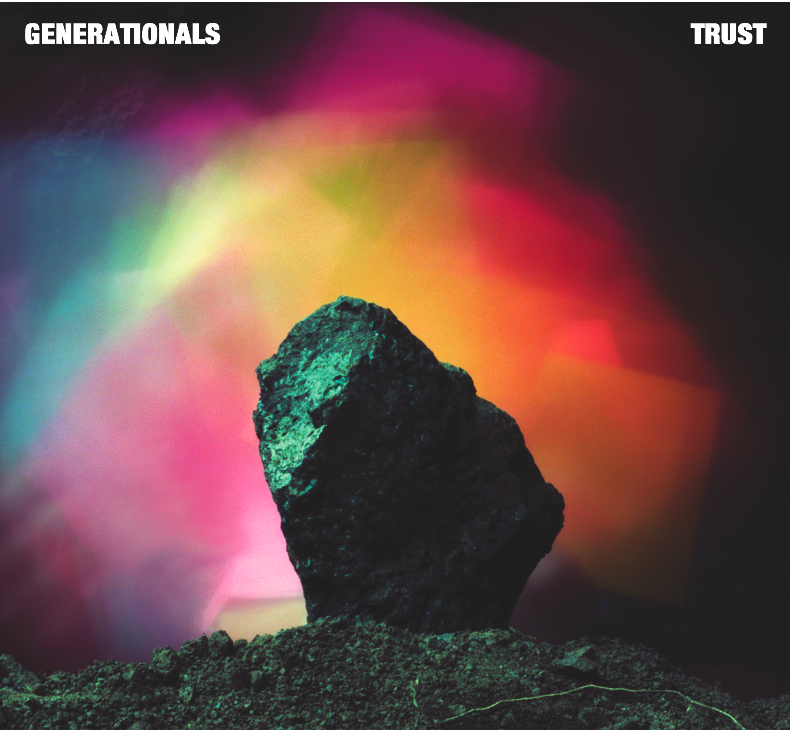
Generationals is a spunky little trio out of New Orleans that this past summer went out to Austin, Texas to lay down the four tracks I’ve come to own as the Trust EP. Generationals has been Grant Widmer and Ted Joyner, joined now by drummer and back up vocalist Tess Brunet. Recorded this past August, the EP starts out with “Carrying the Torch”, a poppy bass riff that spins off into an almost indie take on the classic new wave hit “Melt With You.” A tightly loose danceable affair with some light strings in the back round to really make all the tracks blend seamlessly.

“Say For Certain” grooves along organically from the start, pulsing and clicking. A sparse yet melodically decorated tune with some lyrics that definitely got into my head. The syncopation is viral and feels over too soon. “Trust” is another thumping groover with a surfer bend. The song is a mellow poppy jingle that chugs with a beachy sunny sound. I can see the song taking over radiowaves soon, and it is the EP’s title track with good reason, it’s highly infectious. “Victim of Trap” is an excellent closer for many reasons. One being it is a hypnotic, textured, and challenging track that is very welcome after three almost upfront post-pop tunes. The band really builds on each track and it makes me very excited for anything they’re planning on putting down in the studio soon.

The Trust EP is available on the iTunes store now for only $1.99.

BRAIDS Make Lemonade

It takes a lot for four best friends from Alberta, Canada to convince each other to skip college and move across the country to Montreal. At only eighteen, the music geniuses BRAIDS  released a  self recorded/self produced album known as Native Speaker.

With its single “Lemonade” now debuted on Stereogum, new fans can’t wait for the LP’s release on January 18th. The critics can’t wait either, as Filter magazine described the album as “an amalgam of feminine assertion and unabashed lust.”

Illustrated as brilliant in detail and  luminous structure, none of the songs on Native Speaker ever come in under four minutes and most average about six. Such pattern has not bored listeners, but only seemed to sugarcoat the already radiant sound. Leading up to the release, the band will be playing the following shows. Catch them in your city!

***Tour Dates***

11/17 – M For Montreal  With We Are Wolves  Montreal, QC
11/18 – Cabaret Du Mile End WIth Land Of Talk   Montreal, QC
11/30 – Knitting Factory With The Radio Dept.  Brooklyn, NY
12/1 – Bowery Ballroom With The Radio Dept. New York, NY

Album Review: Sufjan Stevens – Age of Adz

Sufjan Stevens can make anything sound beautiful.  Even a song that sounds like it came straight from a Gameboy, which he skillfully demonstrates in his most recent album, Age of Adz.  It opens with the typical Sufjan sound that we all know and love.  “Futile Devices” is hushed vocals and delicate guitar strumming, interrupted by cheerful plucking.  However, any resemblance of another Seven Swans album quickly disappears as soon as the first beat from the next track hits.  Burbling synths and subtly erratic beats in “Too Much” ease the album in a new direction.  And despite the warped trombones and weird synths, “Too Much” preserves the simple beauty that Stevens manages to create in every track.
 
After “Too Much” the “easing” into a new direction ends abruptly, and the album quickly takes off with agressive immediacy.  Title track, “Age of Adz,” is sudden and loud, with industrial beats and ominous choruses of “oooohhhs” and “ahhhhhs.”  As the song begins, one might imagine standing in a fiery factory, surrounded by angry builders in welders masks.  But when Stevens comes in, his voice leaves behind the fiery depths and guides the song to a better, lighter place, assuring that “this is the age of adz/eternal living” (whatever that means).  Like most tracks on the album, this song is a true hybrid–fluttering synths alongside a frenzy of stringed instruments and electronic blips blending with majestic horns.  But unless you pay very close attention, the contrast of musical styles goes unnoticed and the sounds fit effortlessly together.
 
Other notable tracks are “Bad Communication” and “All for Myself,” both a little slow and sad.  I wouldn’t call them “downers,” but they certainly evoke feelings of longing and heartbreak.  But beautiful heartbreak.  “Bad Communication” is a subdued, desperate plea to a loved one and “All to Myself” is a gentle, reflective monologue driven by strong lyrics and a passionate, swelling chorus.
 
From electronic beats reminiscent of Enjoy Your Rabbit to folksy guitars and a full-fledged orchestra, Age of Adz has obvious range.  It’s a melting pot of various sounds and styles.  Like Enjoy Your Rabbit met Seven Swans, had a quick encounter with Beck, used the “f” word a few times, and created the score for a musical starring Royal Robertson (the shizophrenic artist whose work is referred to by the album title).  And then turned it into the soundtrack for a Nintendo game.  And as crazy as it all sounds, it’s actually not that crazy at all.  Stevens takes contrasting and somtimes difficult sounds and makes it all fit together in a beautiful, cohesive song.  Which is even more admirable when you place that into the context of a 25-minute closing track.  “Impossible Soul” is 25-and-a-half minutes of musical mayhem.  Yet, that half hour consists of well-structured melodies and strong phrasing that thread the song together and turn something that one might hope to be “endurable,” into something that is remarkably enjoyable. 

While Age of Adz might be seen as going in a “new” direction for Stevens, it is, in fact, a culmination of “old directions.”  Stevens has gathered his experiences from previous works to create an evolved–but somewhat familiar–collection of strange and beautiful songs.

Cheap Time Returns With New Album

Two years after the release of their self titled debut album, the Tennessee-based garage rock band, Cheap Time are back with the release of their second, Fantastic Explanations (and Similar Situations).  For those familiar with the original grunge/punk sound of the group’s original album, you are in for a surprise with its successor. While remaining true to their original kicks and beats, the band has collectively matured into the band we all hoped they would.

Fantastic Explanations (and Similar Situations) doesn’t only differ from the bands previous work in musical maturity, but the fashion that it was recorded is also very altered. While the band was finishing up recording the album ,their engineer suffered a mental breakdown and kicked the boys out of the studio by gunpoint. It wasn’t until months later that another engineer was hired to finish the job.

Despite this tragic experience, the band is currently on tour in Europe but US tour dates are on their way.

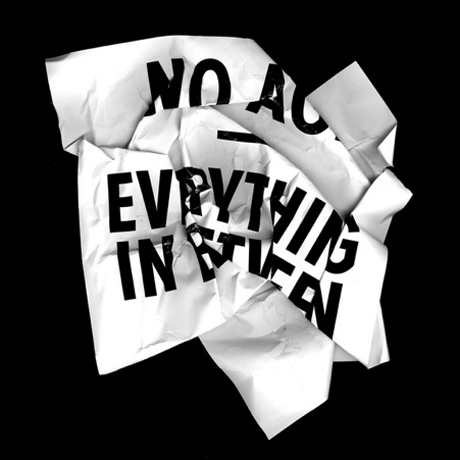
No Age – ‘Everything In Between’


No Age’s second album for Sub Pop, Everything In Between, builds upon the mastery of their dirty clean sound which traces its antecedents through New York No Wave, Modern Noise, Dream Pop, Hardcore and the kind of adolescent punk which sprung from the ether in LA over the past decade.

Dean Spunt and Randy Randall are musicians using a solid combination of guitar and drum and effects, aiding the normalization of other recent break out two-piece acts such as Japanther, the late and much lamented Death From Above 1979, The Black Keys and Japandroids who use noise in less an abrasive manner than in service to the songs.

This is most apparent on Everything in Between with the excellent “Fever Dreaming” whose distressed and scorched wails are the amazing guitar noises that are half broken robot, half toy keyboard and half screech of tires. Yes, 150% awesome. That’s “Fever Dreaming.”

Though they step out of the expected mold time to time on this album such as with the quiet duet “Chem Trails”, these soft butterflies of chaos are not the songs that you’ll find yourself returning to or adding to party playlists.

Everything in Between isn’t quite a move forward or evolution of the sound No Age has been kicking down stairs since their first compilation Weirdo Rippers. Rather, it’s a lateral move from the excellent Nouns whose combination of minimalist compositions and maximum rock n’ roll got No Age the well-deserved recognition beyond the loft show set.

Frankly speaking, despite the missteps and seemingly out of place songs, Everything In Between contains strong contenders for your year-end Songs of the Year listings while those same growing pains don’t quite coalesce just yet for No Age over all. It’s tempting to hope that this is somewhat of a transitional album and that they are able to once more make the musical leap from the growth demonstrated in Weirdo Rippers to Nouns.

Make no mistake, Everything in Between demands your undivided attention and you would do well to grant it.

Album Review: Crocodiles – “Sleep Forever”

Last year, duo Charles Rowell and Brandon Welchez caught the attention of many with the dark and druggy post-punk Summer of Hate and its less than subtle influences of The Jesus And Mary Chain.  And while Crocodiles lean heavily upon these influences, almost mimicking them, their sophomore album, Sleep Forever, shows that their music is starting to form its own identity, becoming good enough to stand on its own.

 With James Ford of Simian Mobile Disco producing this album, the layered instruments are bolder, complimenting the more developed, sharper song-writing of the San Diego band.  The opener “Mirrors,” begins with slow and subtle beats, unfurling into an 80s-esque upbeat blend of psychadelic synths and echoing vocals.  “Stoned To Death” follows by immediately jumping into a swampy, drum-heavy repitition of distorted riffs and distant vocals, later accompanied by an organ.  “Hollow Hollow Eyes” is one of the better and funkier tracks, where the band’s heavier use of the organ helps to swing the song into a mesmerizing swirl of sound.  Crocodiles explore their range of sound with the slower, romantic “Girl in Black” and the more poppy “Hearts of Love.”  With the explosive sing-along chorus, accompanied by a tinkling glockenspiel, “Hearts of Love” might be the catchiest track on the album. 

 Sleep Forever is an improved extension of the smeary, gritty sound of 2009’s Summer of Hate.  It’s eight tracks of louder, fuller and more concrete jangle noise pop.  I would commend Crocodiles for their progress.  Still, the album retains a similarity to the last–it’s enjoyable but certainly not revolutionary.