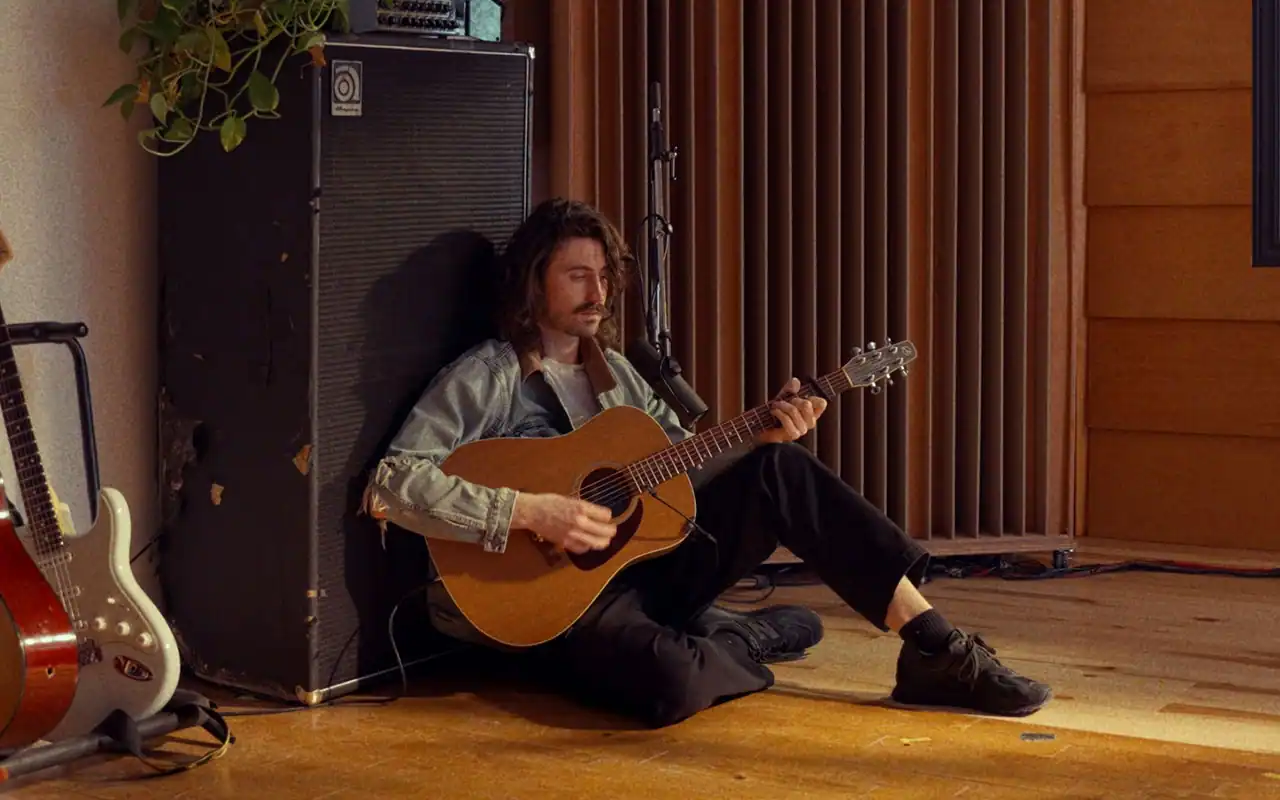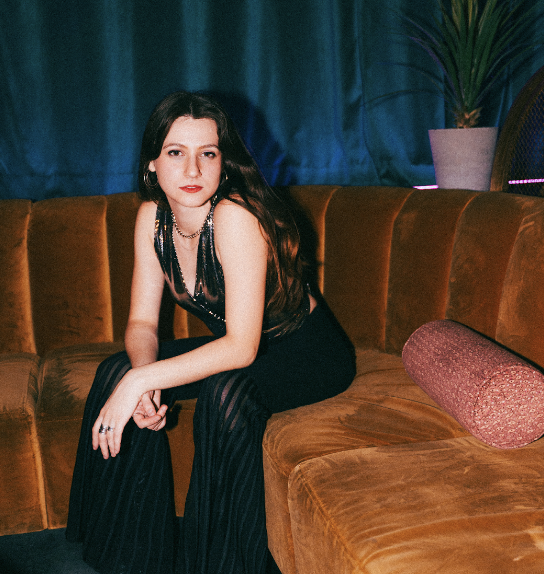
Fresh off the heels of his contribution to Songs From The Gang, 5x JUNO-nominated singer-songwriter Julian Taylor returns with “Dedication”—a vibrant new single that blends soul, roots, and folk rock with a deeply personal message about commitment, connection, and showing up with your whole heart.
“Dedication” is the first single to be released from Taylor’s forthcoming Anthology II, a career-spanning collection to be released on September 10th which traverses his over 25 year career as a songwriter.
Recorded in a single, spirited session with an all female, kickass band made up of Michele Stodart on bass, Raevennen Husbandes on electric guitar, and Sian Monaghan on drums, the track captures the collaborators’ undeniable live energy.
“[We had] a super tight rhythm section, killer guitar, great backing vocal harmonies and it all locked in perfectly. I don’t think we had even played our first show together yet when we recorded this and it was an incredible experience getting to know one another. We hadn’t even played our first show together yet when we recorded this, but it clicked instantly,” Taylor recalls.
“We’re life long friends now and I love playing with these dynamically talented women every time I go across the pond.”
Co-written with longtime collaborator Robert Priest, “Dedication” is a song born from real love and persistence. With its rich emotional message wrapped in infectious rhythm, Taylor delivers a heartfelt anthem that invites listeners to dance while also reflecting on what it truly means to give your all.
“Whether that’s in love, in life, or in your passion, this song is a declaration of that kind of wholehearted commitment,” says Taylor.
Inspired in part by a simple moment at a street corner, the lyric “take me along across this crosswalk” captures Taylor’s knack for turning everyday moments into poetic imagery.
“Relationships are like crosswalks,” he explains. “Sometimes you’re waiting, sometimes you’re asking someone to take that step with you.”
Stylistically, “Dedication” leans into a retro, soulful sound anchored by tight rhythms, rootsy guitar licks, layered vocals, and a memorable “la da da da da” refrain that gives it instant singalong appeal.
The result is a track that’s brooding and devoted, uplifting and fun—one that moves both body and spirit.
“It lifts me up every time I play it,” Taylor adds. “And I hope it does the same for others.”
Toronto-based singer-songwriter Rosanne Baker Thornley unveils the official music video for her beautifully introspective single, “Her Mother’s Eyes” – a cinematic, heartwarming track inspired by the quiet, emotional power of a single wedding morning photo. Framed through a mother’s gaze, the song pays tribute to the intricate, ever-changing relationship between mothers and daughters.
Drawn from a deeply personal experience, “Her Mother’s Eyes” paints a vivid scene: a daughter on her wedding day, the final touches of makeup being applied, a veil waiting in the stylist’s hand — and a mother witnessing the culmination of years in one fleeting moment. It’s a song that acknowledges the little girl who still lives within the woman standing before her, and the life they’ve shared leading up to this day.
Thornley‘s signature vulnerability and lyrical honesty guide the track, giving voice to emotions rarely explored in contemporary folk and singer-songwriter spaces. With cinematic grace and gentle restraint, the song unfolds like memory itself – tender, truthful, and timeless.
1. Tell us the story of this song, why did you choose to visualize this song specifically?
“Her Mother’s Eyes” is a song that stirred in me when I was looking at the photos I took the morning of my daughter’s wedding. This is a song that captures what was, in one particular photo, an overwhelming feeling that I couldn’t pull away from.
For what was a ridiculous amount of time, I sat there looking at the photo filled with such intense emotion as I looked at my daughter getting the final touches of her makeup applied, and the hair stylist standing behind waiting to place her veil. It was in that moment, and a look on her face, that I could fully see that little girl of mine andthe lovely woman she had become.
I’ll never forget how that felt. And how I knew in that moment that I had to capture what was inside of me. It’s the depth of that love and that feeling that inspired me to write “Her Mother’s Eyes”.
I write from a space inside a song where I can feel as well as see the moment and setting around me. A song is as much audio as it is visceral and visual for me. There’s something very sensory in all of it. And because of my passion for taking photos, I’m inspired to capture these moments which I feel do much the same as what a song does.
2. What was the inspiration behind this video (visuals, storyline, etc.)?
To immerse people in a song, in a lyric, in a feeling, in the space of a moment … and to have them hear, feel and see those 3 minutes 35 seconds, to pull the audience into your song through their heart, their eyes … how soul-fulfilling is that …
Because of the strength of the story behind “Her Mother’s Eyes”, I didn’t feel that the video needed to spend a lot of time focused on me singing. Infact Director – Yeimy Daza, Cinematographer – Artem Mykhailetskyi and I agreed that the story was better served having me appear at the end in a cameo to establish whose eyes you were experiencing this through.
We knew we wanted to draw on the emotional connection of the song and to share not only the experience of seeing the bride through a mother’s eyes, but to also share the mother seeing her daughter as a young child. There were quite a few discussions around how we would accomplish this, as well as thoughts on the camera being the mother’s eyes, which determined the position of the camera – and how the camera (the eyes) experienced the room. We also discussed a more filmatic approach to setting the scene and staying in the calm of it.
I love black and white imagery which I leverage in my own photography work. I love that b&w simplifies what you see and channels your focus through a less busy palette. I love that it immediately immerses you into a thoughtful moment. A moment that is romantic, thoughtful, dramatic, sophisticated, powerful, immediate.
3. What was the process of making this video?
My visual team and I had been discussing this video for years. In fact this song was originally going to be the first single from my album “Sorry I’m Late”. But when Covid changed the landscape, it made no sense to release a song about a wedding.
We had had for quite some time the video treatment. So when I hit the green light on releasing the single recently, it was game on for getting this video into production on a budget that was fueled more with generosity and a want to be part of it, than on dollars. I must say that my videos reflect far larger budgets than the budgets that actually are. This is made possible only through people who are passionate about creating art they are proud to be part of.
We knew that the video would be an undertaking in finding resources – but we were confident in the song and the team representing what it was we were going to do. We also knew that due to our limited budget constraints that our extensive planning would lead to filming this video in one day.
Finding the right location proved to be our biggest obstacle which I spent endless months searching for – and found and secured, after months of negotiation and emails. Yay! Phew! The wedding dress was attained through Becker’s Bridal a local wedding boutique that my daughter and I have admired the windows of since she was a little girl. When I initially spoke with Becker’s they were trepidated about the notion of ‘loaning’ us a dress, but quickly came on board after hearing the song and reviewing the video treatment. Yeimy’s actor friend Natalia Aranguren, who was herself getting married at the end of May, was thrilled to be part of it. Good friend and casting agent Sam Ottaviano (S.A.M Agency) was instrumental in finding Eva Luna Machin Gonzale who was our lovely child actor. Yeimy, Artem and I were the project producers, which in these so-small productions encompassed all the tasks from producer to craft services to wardrobe to props to picking up and dropping off gear.
So there we were with all the pieces carefully considered, the actors ready to go, a wedding gown loaned and altered, hair/makeup person Audrey Guegan ready with lipstick and hairspray, my daughter Taylor Thornley-Schollar with her camera primed to capture the behind-the-scenes images, my husband Michael waiting in the wings to lend a hand and haul gear, and a long-awaited plan ready to realize! And then at the last minute, our long–confirmed location fell through. Arghhh. Fortunately, in the studio a few days later with my good friend, Producer Ben Pelchat, when I mentioned that our filming location had fizzled, he pointed me to Studio Bon Soleil (Marie Dame) whograciously accommodated our budget, and provided what turned out to be a far superior location to our previous site that had fallen through. The room, those windows, the ceiling height and the daylight streaming through – all of which were a huge priority in creating the look and feel of the video, was absolutely perfect!
The day was long and full and fruitful. It was a day that was a great experience, one that will be fondly remembered by those who were there in the room.
The editing was provided by Youssef Mutawe who fell into the rhythm of the song to create the lovely visual experience – the ebb and flow of a bride and a child as seen through a mother’s eyes.
I’m pleased to at last be sharing “Her Mother’s Eyes” and to have such a beautiful and heartwarming video to carry it into the world. Thanks to the wonderful talent and generosity of my mighty visual team – my village. Thank you Modern Mystery. It’s been my pleasure to share with you a bit of what brought “Her Mother’s Eyes” into the world. I greatly enjoyed the deep dive into how it came to be. Thank you for asking.
Nova Scotia’s Cut Cult share their newest single, “Dinosaur” – a grimy, groove-laden alt track driven by a monstrous baritone guitar hook and an experimental spirit that’s equal parts N.E.R.D. and noise-punk. Anchored in raw live energy and a loose, unconventional vocal take, “Dinosaur” distills the chaotic charm of a rehearsal tape into something big, heavy, and undeniably fun.
Cut Cult is the latest boundary-pushing project from Brian Borcherdt – founder of Holy Fuck, known also for his solo work as Dusted and the viral chipmunks on 16 speed. Reuniting with original Holy Fuck drummer Loel Campbell (Wintersleep, Broken Social Scene, Billy Talent) and longtime collaborator Matt McQuaid (Holy Fuck), the trio formed a new band to explore sonic ideas unbound by the limits of past projects. Rounding out the group is Mairi Chaimbeul, contributing psychedelic harp and synth textures.
Written and recorded in a rural cottage in Black Point, NS, “Dinosaur” emerged during late-night jam sessions, home-cooked meals, and full-band hangs. With its head-nodding 808 pulse and bassy swagger, the song quickly became a band favourite though it lacked a final vocal take. That changed when frontman Borcherdt unearthed a scrappy rehearsal recording and laid it over the session. The timing worked thanks to the shared BPM and the spirit was just right.
We came up with this sort of lumbering monstrous baritone guitar part, something like a scary “Hella Good”-Neptunes kind of hook. We had the title “Dinosaur” due to this Godzilla vibe, but no words. I found a rehearsal tape that was perfect – it was still gibberish, but the vibe was right. Being centred around an 808 beat, I knew it’d fit. So I overlaid that take and was done. – Brian Borcherdt
Montreal-based guitarist/bassist and composer Galamba unveils his vibrant new single, “Sea Shack,” a groove-rich instrumental that dances between Afro-Brazilian tradition and genre-blurring innovation. Driven by joyful interplay between vocals, guitar, and percussion, “Sea Shack” pulses with warmth and movement from the very first beat.
The song draws its roots from Ijexá, an Afro-Brazilian rhythm not often heard in 3/4 time. The choice to use this odd meter, along with funky rhythmic hits inspired by Fela Kuti and a wah-soaked guitar solo, highlights Galamba’s commitment to honouring tradition while reimagining it through a modern, genre-defying lens.
Inspired by a reunion of friends at the festive Gaspésie-based hostel that gives the track its name, “Sea Shack” reflects the spontaneity, connection, and celebration of that moment. Opening with a bold, rhythmic intro, the piece flows into an exuberant exchange of melody and groove before dissolving into an emotive, vocal-like guitar solo that soars above lush harmonic textures.
A standout in the song is the collaboration with Camille Bertault-style guest vocalist Bianca Rocha, whose performance brings an unmistakable sense of joy and soul to the recording, and keyboardist Manoel Vieira, whose Wurlitzer adds a playful, Donato-esque flair.
Following their debut release “On the Road,” progressive bluegrass collective Sourwood returns with “Wrong Carolina,” a rhythmically complex and narratively playful second single that blurs the lines between heartbreak and highway maps. The track explores the chaos of mistaken direction—both geographically and emotionally—fueled by one of the band’s most memorable musical arrangements to date.
“It started with this story [that bandmate Liam Lewis] told me,” says frontman Lucas Last, recalling a tour mix-up where Liam‘s band mistakenly arrived at a South Carolina venue – only to find out they were booked at a bar of the same name in North Carolina. “It seemed like a good opportunity for a double entendre, so I mashed together the ideas of the wrong place, wrong time, wrong person.”
The song’s namesake, “Wrong Carolina,” plays with the ambiguity of place and person, letting the title line hit with layered meaning. “We wanted the lyric to feel deliberately unclear—‘I was in the wrong, Carolina’ vs. ‘I was literally in the wrong Carolina,’” Lucas explains. “It’s simple, but the ambiguity is where the real emotional weight is.”
Thematically, the song confronts the moments when confidence turns to confusion—when being sure of something doesn’t make it right. Musically, it’s a standout within Sourwood’s catalogue: pulsing with tension, intricate in rhythm, and laced with the dynamic push-and-pull that has already become a band signature.
The track’s distinctive sound is built around interlocking instrumental patterns, with rhythmic motifs repeating across guitar, mandolin, fiddle, and upright bass. “It almost feels like a prog-rock section passed through a bluegrass filter,” says Lucas. “The way everything locks together creates this feeling of momentum, like a train barreling toward a switch that no one’s pulled yet.”
Despite being the most technically challenging song on the record, it came together surprisingly quickly during a live-off-the-floor session at Halo Recording Studio. “We were intimidated by it—lots of stops and starts, and a very specific arrangement—but we got it in about three takes,” Lucas recalls. “It felt like magic.”
Produced by Roman Marcone and engineered by Danny Smart, the song also showcases Sourwood’s willingness to push sonic boundaries. From phasers on banjo to ambient textures more common in indie rock than bluegrass, the track embraces experimentation. “When I came back to hear the mix, Danny had added all these weird effects. Roman looked nervous, like maybe he’d gone too far,” Lucas laughs. “But I loved it. It was the first time I’d ever heard a banjo run through a phaser and just said, ‘Let’s go with that.’”
With “Wrong Carolina,”Sourwood continues to stake out new territory at the intersection of folk, bluegrass, and indie, pairing genre-defying instrumentation with storytelling that feels both intimate and mythic.
There are few performers who embody the spirit of Nashville’s Lower Broadway like David Graham. A longtime fixture at beloved honky tonk haunts like Robert’s Western World and Layla’s, Graham earned his stripes the old-school way—by playing night after night, delivering blistering sets that blend classic country, blues, and rock ‘n’ roll with irrepressible swagger. As frontman of the rowdy hillbilly trio The Eskimo Brothers, he became known for his magnetic stage presence and tireless work ethic. Now stepping further into the spotlight, Graham’s new solo album Downtown captures the grit, heart, and honky tonk soul that he’s spent years perfecting on stage.
Out today, Downtown is a love letter to the rhythm and chaos of a city he knows intimately. From the foot-stomping opener “Big Time Tonight” to the haunting, cinematic “Ghost Town,” Graham showcases the range of his Americana roots influences while staying true to the live-wire energy of his performances. The title track, featuring harmonies from his daughter, reveals a more personal side, making Downtown not just a musical statement but a reflection of a life spent chasing songs in smoky bars and neon-lit corners of Music City. Before his release show at Layla’s this Sunday, Graham sat down with us to talk about the record, the city that shaped it, and everything in between.
Do you remember the first time you ever stepped on stage in Nashville? What was going through your head?
The first time I stepped on stage in Nashville was at Tootsie’s. A very surreal experience for me because I had always had a love for Nashville—even as a kid. But I learned very quickly that was not the right spot for me. My first long-standing gig in Nashville was at Robert’s Western World. Even to this day, after playing thousands of shows, it’s still a bit surreal every time I’m down there. The love affair continues.
What artists or records were playing in your house growing up that planted the seed for the kind of music you make now?
Great question. Basically, my parents’ record collection was the start of it all for me—and to this day, still some of my favorite artists. There was lots of Elvis, David Bowie, Rod Stewart, Willie Nelson, Bob Seger, Queen, Glen Campbell, The Stones…
If Downtown were a late-night bar, what kind of people would be sitting at that counter? Cool question. The lovers and the broken-hearted. The winners and the losers. The drunkards and the dreamers. The lost and the found. Everyone.
You’ve been part of the Nashville scene for a long time. How has the city changed for better or worse, especially for musicians like yourself?
The biggest change I’ve seen—besides the population boom—is that Nashville has always been a music destination, and in recent years it’s become more of a party destination. There’s still great music here, you just have to seek it out. And the traffic blows.
What’s the most unexpected source of inspiration that made its way into this record—something not musical at all?
I would say “Ghost Town,” being inspired by the pandemic and how it affected Nashville.
When you’re on the road, what’s one thing you absolutely need with you to feel grounded?
Pictures of my family.
Do you have a favorite line or lyric from Downtown that still gives you chills when you sing it live?
If you wonder where I am tonight Locked in a fire fight Lost in the city lights… downtown.
What’s your relationship like with silence? Do you ever go long stretches without music—or is your world always soundtracked?
I perform so much—silence and I have a very good and close relationship, ha.
If you could go back and give your younger self one piece of advice before your first honky tonk residency, what would it be?
Don’t listen to that negative little voice in the back of your head.
You’re throwing a dream jam session at Layla’s. Dead or alive, who’s showing up to play with you—and what song are you all closing the night with?
Chuck Berry Ronnie Wood Rod Stewart Steve Earle
And then I’d end the night with Sinatra and me singing “The Lady Is a Tramp,” sippin’ whiskey with one ice cube 🙂
You must be logged in to post a comment.