Ger Carriere’s latest music video isn’t just a visual accompaniment—it’s a fully realized world. Her single “Can I Be Her” is reimagined through a lens of hyper-femininity, complete with saturated pinks, pastel dreamscapes, and Ger herself cast as a doll navigating her own meticulously crafted fantasy. The result is glossy, charming, and intentionally over-the-top—a perfect reflection of the song’s emotional layers.
The track explores a relationship that has slipped out of balance: the adoration once felt now feels draining, and the longing to feel treasured again becomes impossible to ignore. The video translates that tension into a dazzling aesthetic, wrapping emotional weight in shine and sparkle. While the visuals offer an escapist fantasy, they subtly hint at the emptiness lurking just beneath the surface.
Every glitter-coated smile and pastel backdrop carries a double meaning: playfulness paired with poignancy. Carriere expertly blurs the line between pop art and personal confession, using visual splendor to amplify the song’s themes. The video for “Can I Be Her” doesn’t just decorate the track—it enriches it, deepening the sense of yearning and emotional resonance.
This striking visual statement signals that Carriere’s forthcoming EP promises to be as bold as it is intimate, a fusion of spectacle and honesty that demands attention.
Kat Lee Rivers’ new single, “American Heartbreak (Acoustic Version),” feels like a deep breath in a crowded room—a moment of stillness and grace amid the noise. With only her voice and Bob Lanzetti’s understated guitar, Rivers turns heartbreak into reflection, and reflection into something quietly hopeful.
The song strips away every distraction. What remains is Rivers’ rich, soul-baring delivery—her phrasing shaped by years as a jazz vocalist, her tone both intimate and assured. She sings as if from the kitchen table, transforming “American Heartbreak” from a slogan into a lived experience. The pauses, the subtle harmonics, the space between notes—each detail reveals a tenderness that feels both timeless and necessary.
For listeners new to her, Kat Lee Rivers is an artist whose path has crossed continents and genres. A 2014 finalist in the Sarah Vaughan International Jazz Competition and multiple DownBeat award recipient, she first emerged in the jazz world before expanding into Americana and the rhythmic warmth of Brazilian music. Her debut album, Anything but Ordinary, marked that evolution, blending Americana grit with Brazilian color and jazz sophistication.
Following a period of vocal recovery, Rivers’ voice has returned stronger than ever. Her songs draw on experiences from years living and performing in Spain, Texas, Los Angeles, and New York. She sings in Portuguese and has graced stages from house concerts to iconic (and now-closed) New York venues like Cornelia Street Café and Rockwood Music Hall, as well as The Chapel Restoration in Cold Spring, where she’ll return this fall. She’s performed with the Dallas Symphony Orchestra backing Ben Folds, and toured Europe with Barcelona trio Árid, including a rooftop show at La Pedrera.
Now working with Grammy-winning guitarist and producer Bob Lanzetti (Snarky Puppy), Rivers is crafting a new album for Spring 2026 that deepens her “old soul” sound—one that blends the intimacy of folk with the nuance of jazz.
“American Heartbreak (Acoustic Version)” stands as both a bridge to that upcoming project and a statement on its own: deeply felt, beautifully sung, and rooted in the belief that even in fractured times, a song can still offer a measure of unity.
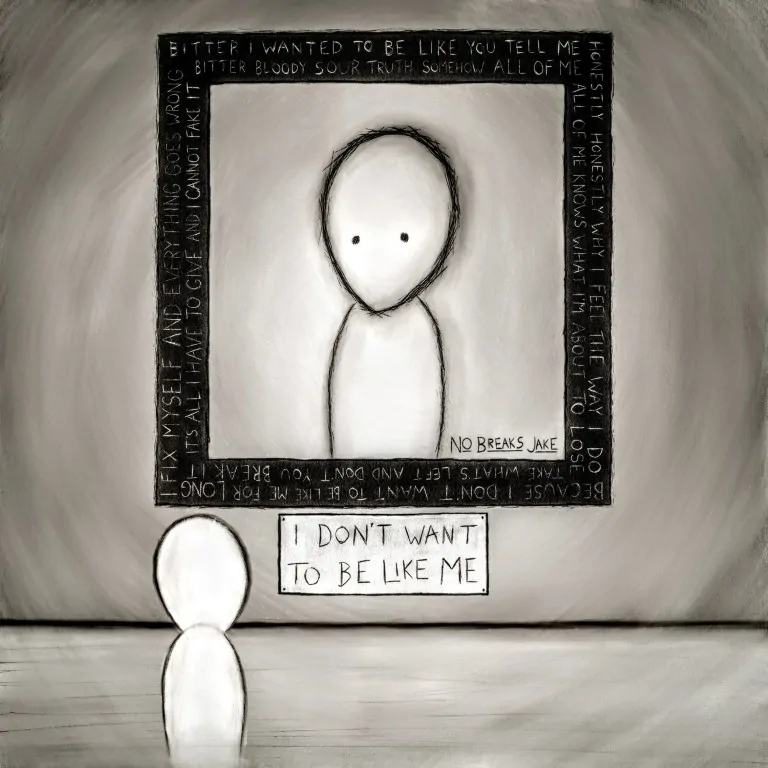
Toronto’s No Breaks Jake returns with “I Don’t Want to Be Like Me,” a volatile, slow-burning alt-rock track that grapples with identity, guilt, and the longing for self-reinvention. It’s a heavy, emotional unraveling – one that begins in quiet vulnerability and erupts into a wall of fuzzed-out guitar riffs, cathartic screams, and sky-is-falling chaos.
The single marks a thematic cornerstone of No Breaks Jake‘s upcoming Amygdalan EP, setting the tone for a project that doesn’t shy away from the harder truths. “This song evokes a state of mind that, honestly, I’m trying to leave behind,” says bandleader Jacob Kassay. “Actually doing that is definitely a little harder.”
Written and self-produced in Toronto, the song evolved through a dozen different iterations and multiple structural overhauls before landing in its final form. “It was all about telling the story effectively,” says Kassay. “I love how it builds from something intimate and restrained into a screaming mess. There’s something satisfying about watching it all fall apart.”
1. Tell us the story of this song, why did you choose to visualize this song specifically in this way?
The first lyrics written were the first you hear: Bitter / I wanted to be like you / Tell me honestly, honestly / Why I feel the way I do. Right away, I knew I was writing about some of the ugliest, most unlikeable traits I have as a person – toxic, jealous, empty feelings. I think we can all relate to having those thoughts, and wanting to outgrow them – but it’s never easy, and it tends to take quite a long time. It’s always two steps forward and one step back. This song is about carrying those expectations, shaking under the weight, until finally everything gives out and you break entirely. That’s okay too, remember – two steps forward, one step back. We can keep moving forward after we recover. Right now we need to stumble.
Most of my favourite art could probably be pigeonholed in this category of having these heavy, depressing themes that deal with the darker side of life, but I think that’s where the beauty is. Life can be scary and impossible and chaotic. Art is about having the courage to confront it anyways. All I want to do is create with integrity in this fashion. This video is my attempt at trying to capture that integrity.
2. What was the inspiration behind this new video (visuals, storyline, etc.)?
The song being what it is, I was fascinated with this general idea of ‘looking at yourself’. Early on, I landed on the visual of the broken mask, this perfect facade that had cracked and something ugly was seeping through. The decision to make it eyeless was one of those happy accidents; earlier sketches looked more like a typical china doll, with big doe-eyes, eyelashes, and lips, but I wasn’t great at drawing it and simplified the design. What I ended up with really struck me because suddenly there was this connotation of self-inflicted blindness. It’s the mask we all wear, the one that hides everything about ourselves we can’t see – or don’t want to. And apparently, in this haunted art gallery, it comes to life, sprouts an eldritch body, and tries to kill you. How fun.
It was important to me that the storyline of the video wasn’t too oppressive or hopeless. I wanted our hero’s journey to reflect my own feelings about the song: things aren’t looking great, but that doesn’t mean we can’t make them better. We’re not giving up. So I had him fight back, outmatched though he was. Things end a little ambiguously, too; it’s unclear who won the fight, or if either of them might get back up. But I like to think that the point of my little tale isn’t how it ends; it’s that he chose to take up arms in the first place.
3. What was the process of making the video?
First, I just gave myself a premise. What would be interesting to draw, interesting to see? More importantly, what gets across the message of the song? And once I had that premise, that haunted, monstrous, mask… thing, I could map out key visuals that fit the biggest moments in the song.
I’m generally not such a ‘storyteller’ songwriter. I don’t want to keep track of characters or plot points or chronology; I like songs that embody an emotion, a thought, a feeling, and then hit you as hard as they can with it. Fittingly, the video plays out less like a story and more like a dream: scattered, fleeting images strung together, carrying you from one idea to the next. I had several sort of ‘big moments’ in my head: the unearthly presence of the mask, the monster that grows from it, the haunting, judgmental stares of the painting it emerged from, or especially that shot near the end of the monster in its largest form, coiled like a dragon around this terrified but unflinching hero. From there it was about connecting the dots, like trying to unravel what must have happened to end up in this place.
Toronto’s The Holy Gasp return with the video for “Out of the Hands of the Wicked,” an award-winning live action puppet musical drawn from their critically acclaimed 2003 orchestral album …And the Lord Hath Taken Away. Rooted in good ol’ fashioned southern gothic, porch-stompin’ devil music, the track blends old time-y folk Americana, gospel fervor, and theatrical storytelling into something at once darkly comic and deeply human.
The cinematic counterpart for “Out of the Hands of the Wicked” has already racked up an impressive string of accolades on the festival circuit, including Best Music Video at the Regina International, Best Film Music at the Paris Film Art Festival, Audience Choice Award at Tiny Mountains Film Festival (Australia), and a Best Film Score nomination at Blood in the Snow. As Grimoire of Horror predicted, “it is the creativity and the memorability of [Benjamin] Hackman‘s performance as Pa that are going to win this short some awards” – and they were right!
1. Tell us the story of this song, why did you choose to visualize this song specifically? The video itself tells the story of a family of southern dustbowl puppets. After a harrowing journey home from hell, their patriarch, Pa, boasts of his triumph over evil and how he came to lock the devil in his heart. Against the protests of his family, Pa then must return from whence he came to save the ones he loves from the hands of the wicked. But though his family may be safe from evil, how far does any one man get with the devil locked inside his heart?
Me and the folks in The Holy Gasp had been having a gay ol’ time making videos for other tracks off our album, …And the Lord Hath Taken Away, and had already made two live action videos (In Amsterdam and Havel Havalim) and two animated videos (The Algonquin Bridge and Devil Oh Devil), and just really wanted to work in a medium we hadn’t worked in before and answer the call of that very basic artist desire: to try something new and to be playful and creative. The call-and-response vocals in “Out of the Hands of the Wicked” were already musical theatre-esque and we just thought it’d be fun to work with singing puppets. What more can I say? It all looked fun.
2.What was the inspiration behind this video (visuals, storyline, etc.)? Storywise, the script was inspired by southern gothic literature – in particular the works of Flannery O’Connor and Tennessee Williams. Visually, we mainly drew from the Kansas scenes from The Wizard of Oz, John Ford’s film adaptation of The Grapes of Wrath, and Roy Stryker’s “Killed Negatives,” which I hope readers will spend some time with if they haven’t already, as they offer a remarkably intimate insight into the hardships of American life in the 1930s, and are some of the most gorgeous documentary portraits I’m aware of in existence. As for the design of the puppets themselves… character design is always, in a sense, the invention of a new species. Kristi Ann Holt was given quite a bit of freedom to concoct a new species as she saw fit, within the broad strokes of the visual references she was provided. We knew we wanted to stay away from cuddly fun fur muppets – both because material costs were still, during pre-production, affected by COVID and therefore prohibitively expensive, and because we wanted to explore the full scope of puppetry as a theatre form and medium, and not feel relegated to what-we-think-of-when-we-think-of-puppets. I confess I can’t remember Kristi and I discussing what the puppets would actually look like, only their mechanism. I think it was a process-oriented journey for Kristi in which she discovered the genetic makeup of each puppet as they revealed themselves to her through the process of making. I wish I could remember this part of the process better. I’m gonna call Kristi later and ask her. In the meantime, readers should reach out to her directly and ask her more about it: https://www.anarkiti.ca/
3.What was the process of making this video?Quite difficult, I should say. Puppets can be vulnerable artifacts with delicate mechanical structures, and compelling puppet performances often require exuberant gestures, highly expressive movements, and a bit of overemphasis in lieu of moving eyebrows, lips and cheeks – all those things that physical actors have at their disposal but which many puppets do not. The consequence of this is a lot of broken puppets, which, in my experience of our one-day shoot, frustratingly caused so many delays in production that it was hard for me to feel like I was able to maintain a flow of creativity, and many scripted and storyboarded moments had to be cut for time and budget. That’s indie filmmaking, though, and in the end, extraordinarily talented puppeteers and editors made a piece of art I’m unquestionably proud of. Contrary to what I said in an interview in Blood in the Snow, I would work with puppets again, but perhaps less of them. I encourage readers to explore what can be accomplished with low budget puppet productions, so that we can all learn more about what is possible for the independent artist working and creating in this beautiful artform.
After a 20-year hiatus, Andrew Spice returns with With Animals, a powerful reclamation of identity and emotion from the depths of trauma and detachment. Anchoring the record is “Junk,” a raw, defiant indie anthem that takes aim at the emotional erasure caused by psychiatric medication and the quiet rage of wanting to feel again.
Produced by two–time JUNO nomineeMatthew Barber and featuring acclaimed musicians Mike Tompa, Marshall Bureau and Devon Henderson, With Animals is a deeply personal collection of songs about survival, self-reclamation, and the radical strength of vulnerability. Piano-driven and poetically potent, the album traverses themes of sexual violence, emotional isolation, queerness, and the healing power of animals. Its most biting track, “Junk,” turns gut-wrenching experience into something electric and alive.
“During the difficult time when I wrote these songs, I sought help through psychiatric meds,” Spice says. “‘Junk’ is about realizing that they were erasing more than just the pain, and the fight to feel like myself again.”
Midnight Channel unleashes their boldest, most emotionally raw track yet with “Celebration,” an overwhelming, unrelenting jazz composition that captures the chaos, beauty, and relief of simply surviving. Propelled by frenzied percussion, free-form improvisation, and a deep spiritual core, the song is both abrasive and serene – a noisy yet peaceful meditation on being alive.
“‘Celebration’ is celebrating that you’re still here. There’s nothing more important than that,” shares bassist Matthew Erdmann. “It’s about overcoming dark times/suicidal thoughts and accepting yourself. It’s about celebrating missed opportunities, as well as the ones you’re risking everything to take. It’s also about celebrating the end of another album, which always leaves me feeling empty but at peace.”
Written as both a personal anthem and a collective ritual, “Celebration” draws inspiration from church hymns, Pharoah Sanders, Cecil Taylor, and Zach Hill – a spiritual jazz piece meant to feel emotionally overwhelming at first, but comforting the more you sit inside it. The drums are chaotic but compressed, letting the melody float above like a breath of air. “If you separate the drums and melody,” Erdmann notes, “you’d have two completely different songs.”
At its heart, the track celebrates being in the present moment.
“This single is for the freaks,” Erdmann adds. “We chose it because it hits people over the head right away – that this is what we’re doing, and we’re not sorry for it.”




 Modern Mystery
You must be logged in to post a comment.