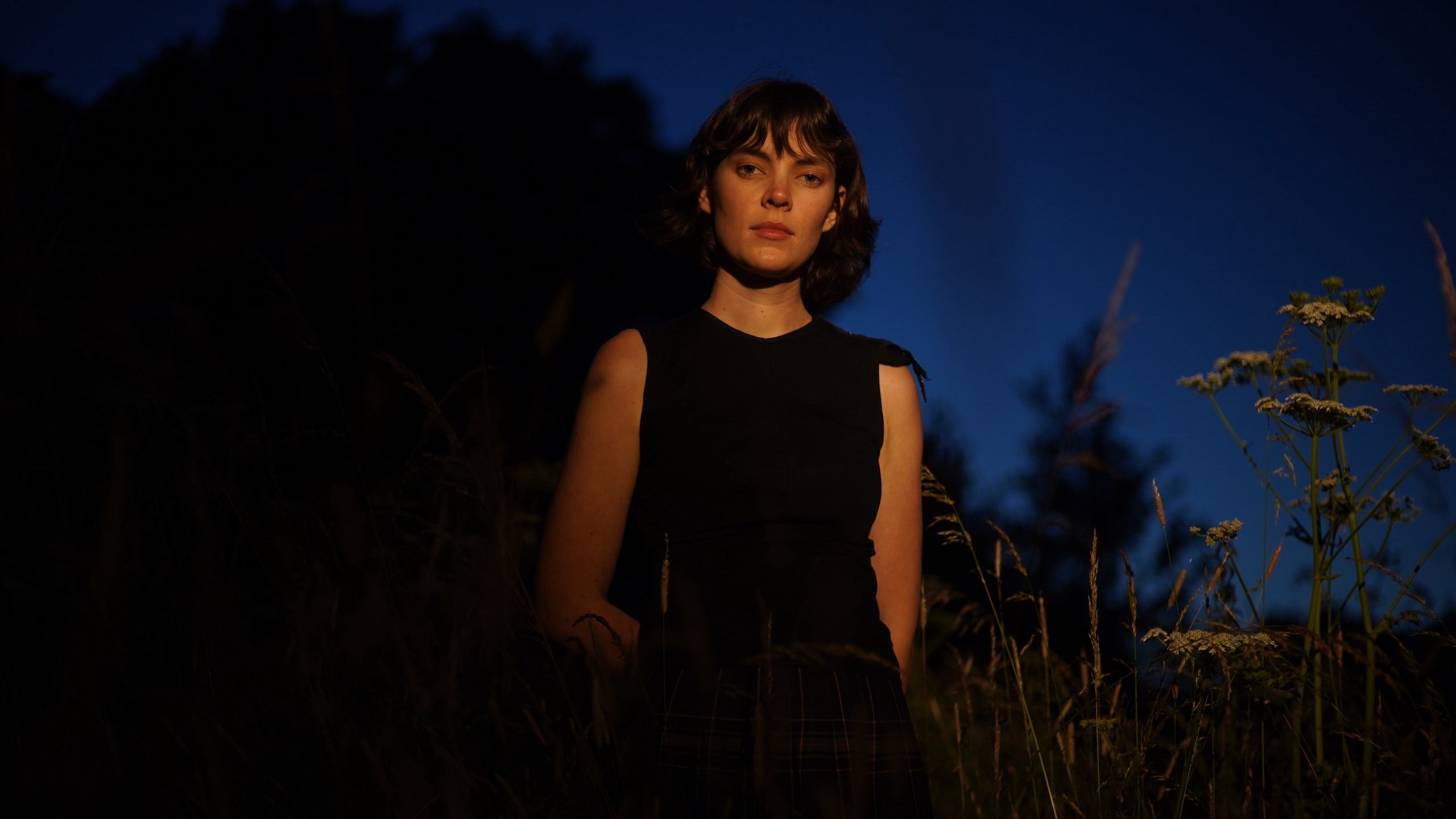
With her first album Undertow, out today, London-based composer/singer-songwriter Sophia Hansen-Knarhoi reveals stark vulnerability nestled in a dark ambience that is both intimate and expansive. Voice and cello provide the bedrock of a detail focused record, that threads together memory, grief, growth and connection. Undertow took its shape during an acclimation of sensuality and self, through a period of processing trauma, and all of life, love and loss that it surrounds and intertwines with. ‘Undertow’ binds this intimacy with the corporeal, spanning violation and deep trust. It deals with the fallout of the victims of violence against women, voyaging through fear and pain to absolution. After releasing the first single, “Crying in Pastel,” & “My Mother and Me” today, Sophia releases the video for “All the things that aren’t you”.
Sophia explains “This track captures a moment of rage, a realisation of being treated in a way that only served the other person, without regard for mutual connection, and a recognition of this as a pattern from the past. It poses a sense of freedom through this recognition of negligence.
OOO
On my way to heaven
I hope you die first
I want to feel wild
You make me feel mild
Forgive me I’m ruthless
When it comes to you
And when I say I want to be alone
I don’t think that’s true
I want to be surrounded
By all the things that aren’t you
Set to the backdrop of a field recording of a torrential storm, the cellos interchange in glissandos. There is a lot of space for the world of the field recording, with the distant ‘oos’ give an impression of a feeling from the past, a meandering thought before a moment of clarity. The field recording itself was taken the night of a huge storm. As I recorded from my windowsill, a tree in the bushland across from me was struck by lightning, and burst into flames.
The scathing lyrics come in with force and a grittiness, accentuating their dramatics, feeding the rageful delivery. The vocal melody glides with the cello glissandi, we hear whispered trails of the lyrics, and bold echoed backing vocals. The double bass feels as if it’s closer to moving in the world of the rumbling thunder.”
“The cello is widely considered the closest instrument to the voice. This is something that continually bleeds into my practice, finding the connection between voice, cello and body. The physicalization of this combined practice creates a sense of corporeality in my sound. I let it be intuitive, my playing and singing guided by my breath and the way my body moves. I found the duality of this expression informed reflections of sensuality and intimacy throughout the album.”
Undertow coalesces in a unique combination of clarity in its folk/singer-songwriter storytelling with a wholly alive and reactive bed of instrumentation. Instead of traditional structures and overly virtuosic solos, all aspects of production and performance lean heavily into spontaneity and gut feeling, reaching closer to a sense of unfiltered emotional truth. The result is an act of reification: songs with a sense of touch, of ears and eyes and flesh, coming to life around the mouth.
Sophia’s expressive, unbound cello performances – informed by a background in improvisation – sonically embody the rapids rushing beneath the honest lyrics. In songs where the voice falters under the weight of the words, the cello scrapes and detunes in tandem. In moments of fragile triumph, a soaring falsetto is accentuated with buoyant layers of open-string harmonics.
With the skilled Brooklyn producer Randall Dunn as a collaborator, Undertow pushes further into the abstract, a dark and dissociative space. Dunn carves intricate space with vast void-like atmospheres and cinematic intensity, with an unrelenting foregrounding of vulnerability. With instrumentalists Peter Zummo, Marilu Donovan, Henry Fraser, Luke Bergman and Brent Arnold, the arrangements on Undertow draw breath into a minimalistic sonic landscape, occupying a cohesive improvisational latitude.
Her 2023 debut EP, Wildflowers, explores the transition from childhood to adulthood, blending ethereal, delicate vocals with graceful and tender instrumentation to embody memory, trauma, and the moments that shape us. “My storytelling comes from a deeply emotional and intuitive space. But it also serves as a reflection of the web of lives and stories that are woven through my life.”
Born in Perth, Western Australia, Hansen-Knarhoi grew up surrounded by the natural world. ‘Undertow’ draws on the stark landscapes and vast waters of Western Australia. At moments, field recordings are woven into the work, while at others, arrangements reflect its beautiful barren environment through memory. “Engulfing myself in nature has always been a way for me to process the world, to bring me back into my body and my senses”. ‘Undertow’ revels in this remote sonic landscape, submerging stories in the depths of truth.
Hansen-Knarhoi’s origins as a composer coalesced in her early teens. “I would sit in my bed at night after school and write at least one poem a night.” In these moments, she built the foundations of her storytelling voice. “It was purely for myself. I didn’t want anyone to read them at the time, and created melodies for my words, sometimes drawing maps. Singing these melodies to myself would imprint them into my head.” Today, informed by a world of musical knowledge, Hansen-Knarhoi embraces folk music as a practice. “This aural tradition, I have found, is still my truest form of creative expression. To understand the song, one must listen to the delivery, feel the weight of the words, and understand the elements and intricacies that make the song what it is.”
The hypnotic spiralling harp and methodical bass that comprise the bedrock of “Crying in Pastel”, acts as a world in which a lyrical vortex of sorrow cuts through the track’s serenity . Hansen-Knarhoi’s voice is raw and gritty, as she sings, “Did you think of me?/Something pretty?/Are you scared of me?” “Crying in Pastel” vacillates between anger, fear and sadness, all feelings that coexist in grief. Rage and ruin juxtapose a hope for connection, a need to understand the psyche of a predatory man.
Undertow frames Hansen-Knarhoi in a transitory state, continuing her evolution, and all the sharp objects in the way. “Although rage is a cornerstone of its being, it is grounded in a hope of connection, a sense of healing on the horizon.” Music stems from a consciousness that preceded language, it comes from our ancient mind, from before our emotions were clouded by reason and rule. It still takes us back to the raw experience of being. This album explores those emotions pulling at our rational selves, taking us where they will.
 Modern Mystery